
REQUEST INSTANT QUOTATION
[jet_search]
Video courtesy of Bombardier.com
Bombardier Challenger 650 Charter: Price & Global Access
Redefining Transcontinental Luxury
Charter a Bombardier Challenger 650 through Instant Private Jet and receive live pricing and tail-specific availability within minutes, not hours. This page connects you directly to operators currently positioning the Challenger 650 for on-demand charter, so you can confirm cabin configuration, routing, and hourly rate before you ever pick up the phone. Every operator in our network is certified under Part 135 or equivalent international standards, with crews and maintenance records vetted prior to listing. Whether you require a single transcontinental leg or a recurring corporate rotation, our desk sources aircraft across North America, Europe, and the Middle East to match your departure window.
There is a silence aboard the Challenger 650 that money alone cannot manufacture, a hush so deliberate, so architecturally engineered, that the world below ceases entirely. This is not mere transportation. It is a moving sanctuary where every rivet, every radius of leather, and every breath of pressurized air has been choreographed toward a single purpose: your absolute comfort.
With a transatlantic-capable range of 4,000 nautical miles, the Challenger 650 collapses the distances that once defined the limits of a business day. New York to London. Dubai to Singapore. São Paulo to Miami. These are not itineraries; they are statements of intent, executed without compromise, aboard an aircraft that has earned its place as the world’s best-selling super-midsize business jet.
Behind every Bombardier aircraft lies a lineage of over five decades of aerospace mastery — a heritage forged in Montréal, refined in Wichita, and proven on approach paths spanning six continents. The Challenger 650 is not the newest chapter in that story; it is, arguable, its finest. For the discerning principal who demands both performance and provenance, no competing platform delivers with such enduring confidence.
ALL OF OUR PARTNERS ARE CERTIFIED
















Technical Overview
Key Specifications
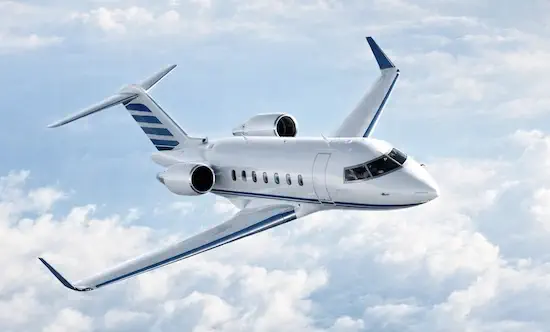
Every dimension of the Challenger 650 has been calibrated to deliver category-leading performance. The figures below represent the aircraft’s full certified capabilities under standard NBAA IFR reserve conditions.
| Feature | Specification |
|---|---|
| Max Range | 4,000 nm (7,408 km) |
| Max Cruise Speed | Mach 0.85 (470 ktas) |
| Typical Seating Configuration | 10 – 12 Passengers |
| Cabin Height | 6.0 ft (1.85 m) |
| Cabin Width | 8 ft 2 in (2.49 m) |
| Cabin Length | 28 ft 5 in (8.66 m) |
| Maximum Takeoff Weight (MTOW) | 48,200 lb (21,863 kg) |
| Baggage Volume | 115 cu ft (3.26 m³) |
Interior & Amenities
The Cabin Experience
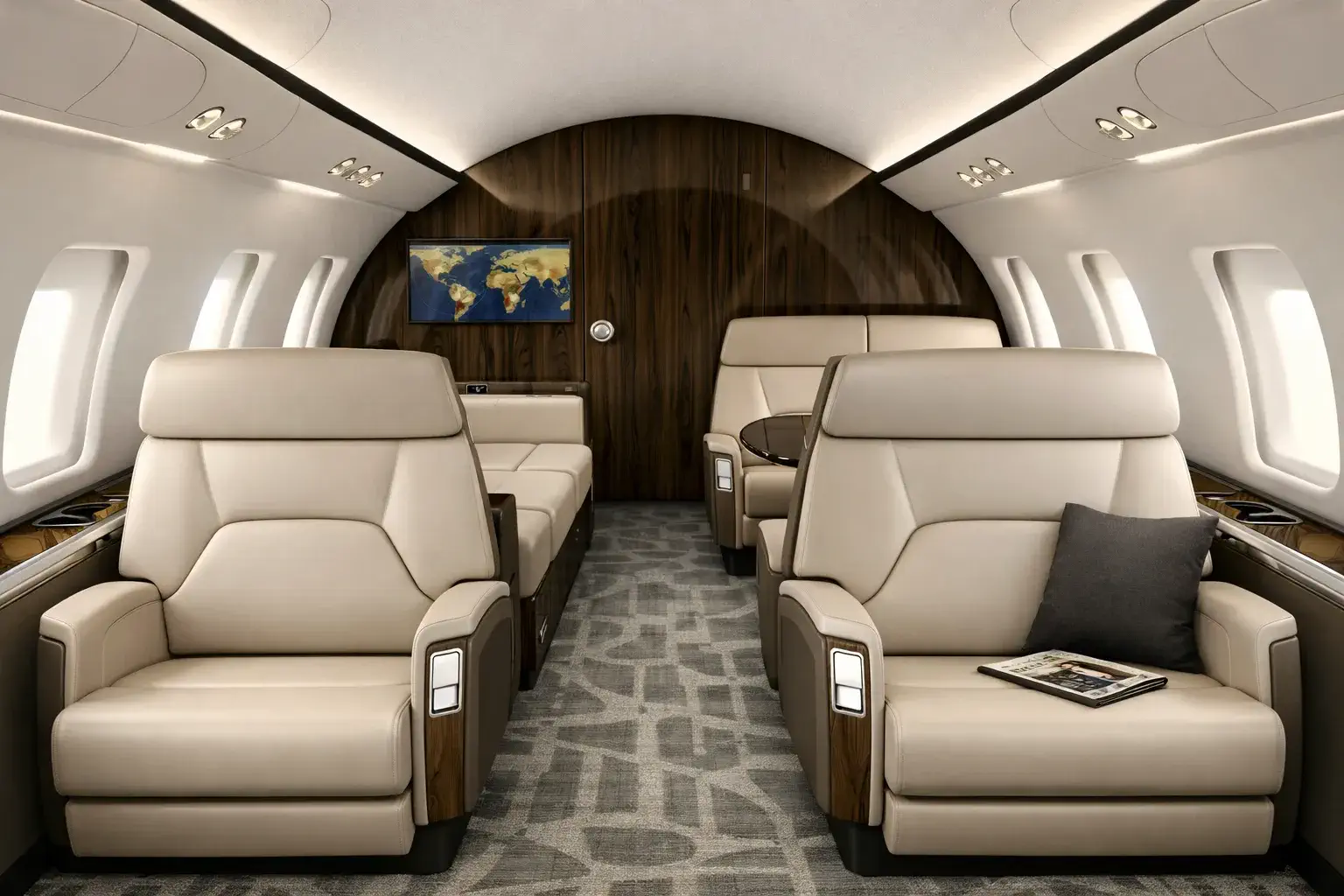
Step through the boarding door of the Challenger 650 and into a cabin widely regarded as the most spacious in its class — a volume so generous it challenges the very category it inhabits. At 8 feet 2 inches wide, it rivals aircraft of substantially greater weight and cost.
Interior Layout & Comfort
The standard ten-passenger configuration typically features a forward club seating zone with fully lie-flat-capable seats, a mid-cabin divan that converts to a berth, and a dedicated aft lounge. Full stand-up headroom throughout means that movement between zones carries none of the stooping indignity found aboard lesser platforms.
The cabin altitude of just 6,000 feet at FL410 — among the lowest in class — materially reduces passenger fatigue, accelerates recovery from long-haul flights, and ensures arrivals that are rested rather than merely transported. Noise levels are kept below 49 dBa, creating an acoustic environment closer to a fine boardroom than an aircraft.

Connectivity & Technology
The Challenger 650 is equipped with Bombardier’s Vision cabin management system, providing intuitive control of lighting (with full LED programmability), temperature zones, window shading, and entertainment from any seat or personal device. High-speed Ka-band satellite WiFi is available as an installed option, delivering broadband connectivity across oceanic routes that once rendered productivity impossible.
Dual 4K HD monitors, USB and HDMI connectivity at every seat position, and optional satellite phone capability complete a technology suite calibrated for the executive who cannot — and should not — disconnect from their world, even at 41,000 feet.
Baggage & Accessibility
An externally accessible baggage hold of 115 cubic feet accommodates golf bags, ski equipment, multiple garment cases, and the substantial luggage requirements of extended itineraries — all stowed out of the cabin to preserve the interior’s uncluttered elegance. The hold is accessible both on the ground and, in part, in-flight via an interior access panel in select configurations.
The forward galley is outfitted for serious catering operations: full refrigeration, a convection microwave, espresso capability, and ample dry storage allow for meal services that honour the culinary standards of your ground-side life. Whether preparing a formal multi-course service or presenting a chilled spread for an early-morning departure, the Challenger 650’s galley imposes no culinary compromise.

Powerplant & Avionics
Performance & Engineering
Beneath the elegance of the Challenger 650’s cabin lies an engineering philosophy that is unapologetically performance-first. Two General Electric CF34-3B turbofan engines, each producing 9,220 lbf of thrust, deliver the kind of balanced power that enables steep-angle departures from altitude-restricted airports while sustaining efficient cruise at Mach 0.85 across oceanic segments.

In line with modern environmental standards, the Challenger 650 is fully Sustainable Aviation Fuel (SAF) compatible. Its optimized wing design and efficient engine cycles contribute to a reduced carbon footprint per flight hour compared to older generations of heavy jets, making it a responsible choice for the eco-conscious corporation.
Objective Assessment
Strengths & Considerations
A transparent evaluation of any aircraft is the foundation of sound acquisition or charter decision-making. The Challenger 650 represents a compelling value proposition, though no platform is without trade-offs.
Strengths
- Widest cabin in class. The Challenger 650’s 8-foot-2-inch cabin width is the defining competitive advantage of this platform — broader than the Gulfstream G280, wider than the Embraer Praetor 600, and a genuine differentiator for principals who prioritise the cabin experience over marginal range gains.
- Superior short-field performance. With a balanced field length requirement well under 6,000 feet, the Challenger 650 routinely accesses airports — Courchevel, Lugano, Teterboro, Nice — that eliminate the inconvenient ground transfers increasingly common among larger cabin alternatives.
- Mature, cost-predictable maintenance ecosystem. As the direct descendent of the Challenger 604, which accumulated over six million flight hours, the 650’s CF34 powerplants and proven airframe benefit from a deep global MRO network, stable parts availability, and one of the most mature hourly-cost programmes in business aviation. Scheduled maintenance costs per flight hour are among the lowest in the super-midsize segment.
Considerations
- Range ceiling vs. newer competitors. At 4,000 nautical miles, the Challenger 650 cannot match the extended reach of the Embraer Praetor 600 (approximately 4,018 nmi with specific payload) or, more notably, the Gulfstream G500 (5,000+ nmi). Ultra-long routes such as London–Los Angeles or Dubai–New York non-stop remain outside the aircraft’s certified envelope, necessitating a technical stop in some transcontinental scenarios.
Competitive Landscape
Market Comparison
The Challenger 650 competes directly with two principal alternatives in the super-midsize segment: the Embraer Praetor 600 and the Gulfstream G280. Each platform represents a credible choice; the optimal selection depends on mission profile, operational base, and ownership philosophy.
| Criteria | Bombardier Challenger 650 | Embraer Praetor 600 | Gulfstream G280 |
|---|---|---|---|
| Max Range | 4,000 nmi | 4,018 nmi | 3,600 nmi |
| Cabin Width | 8 ft 2 in — widest in class | 6 ft 9 in | 7 ft 2 in |
| Typical Seating | 10–12 passengers | 9–12 passengers | 8–10 passengers |
| Max Cruise Speed | Mach 0.85 | Mach 0.83 | Mach 0.85 |
| Avionics Suite | Collins Pro Line 4 | Honeywell Primus Epic (updated) | Honeywell PlaneView 280 |
| Cabin Altitude at Cruise | 6,000 ft at FL410 | 6,000 ft at FL410 | 6,000 ft at FL410 |
| SAF Compatible | Yes (up to 50%) | Yes | Yes |
| Est. New List Price | ~$32M USD | ~$25M USD | ~$25M USD |
| Fleet Maturity | Very High (600+ in service) | Moderate (growing) | High |
Bombardier Challenger 650 Charter Specifications & Booking Essentials
FREQUENTLY ASKED QUESTIONS
Begin Your Journey
Charter, Manage, or Acquire
Whether you are chartering the Challenger 650 for a single transcontinental mission or evaluating it as the cornerstone of your flight department or investment portfolio, the conversation begins with a single, confidential consultation. Our aviation advisors bring decades of combined experience in super-midsize acquisitions, charter optimisation, and fractional structuring — ready to align this exceptional aircraft with your precise operational requirements.
REQUEST INSTANT QUOTATION
[jet_search]
All charter rates quoted on request. Availability subject to operator schedule. Specifications sourced from manufacturer data and may vary by serial number and operator configuration.