
REQUEST INSTANT QUOTATION
[jet_search]
Image courtesy of Image courtesy of Cessna.txtav.com
Cessna Grand Caravan EX Charter: Prices & Live Availability
Cessna Grand Caravan EX Charter Price, Availability & Specifications at a Glance
Data & Prices Updated September 2026 1
Charter a Cessna Grand Caravan EX for missions that demand rugged, short-field performance rather than sheer speed, unpaved strips, remote airstrips, and destinations larger cabin-class jets cannot reach. Prices range from $1,250 to $2,000 per flight hour.
REQUEST INSTANT QUOTATION
[jet_search]
Submit your trip details here to receive confirmed availability and hourly pricing for this specific aircraft, not a generic private aviation quote.
Every Grand Caravan EX offered through this platform is operated by FAR Part 135-certified carriers with verified maintenance records and qualified crews. Positioned across multiple regions, these aircraft provide rapid dispatch availability when conventional jet charter is limited by short runways or unpaved terrain.
For short-haul sectors under 500 nautical miles, chartering a Grand Caravan EX offers a strategic advantage, delivering operating costs 30–55% below comparable light jets. The aircraft combines a spacious flat-floor cabin for cargo or passenger luggage with exceptional short-field capability, accessing remote airstrips unavailable to conventional jet traffic.
Whether positioning a corporate team across regional outposts, deploying specialized cargo, or accessing remote unpaved airstrips, the Grand Caravan EX provides reliable short-field performance and mission flexibility. The following specifications and operational insights outline the key capabilities of this platform for short-haul charter operations.
Why Choose Us for Private Jet Charter
Every operator in our network holds current FAA Part 135 certification, or the EASA equivalent for European operators, the regulatory standard governing commercial charter operations, crew duty limits, and aircraft maintenance oversight. Combined with ARGUS/Wyvern ratings, this means every aircraft you fly with us has passed both government-mandated safety audits and independent third-party vetting.












Cessna Grand Caravan EX Technical Overview
Key Specifications
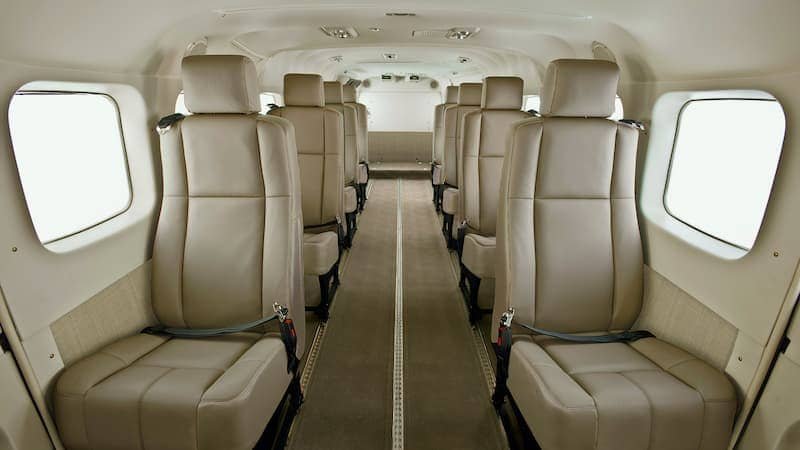
All performance and cabin figures reflect the standard production Cessna Grand Caravan EX as certified by the FAA. Specific seating layouts, payload limits, and avionics packages vary by carrier, and operational metrics should be verified directly with the charter operator prior to booking.
| Specification | Value | Operational Relevance |
|---|---|---|
| Maximum Range | 1,070 nautical miles (with reserves) | Covers most regional and domestic multi-stop missions without fuel stops |
| Maximum Cruise Speed | 175 KTAS | Efficient for sectors under 600 nm; competitive on a cost-per-mile basis |
| Takeoff Distance (Ground Roll) | 1,399 ft at MTOW (sea level, ISA) | Operable from short, unpaved, or grass strips inaccessible to jets |
| Typical Seating Configuration | 9 passengers (standard executive layout) | Configurable from 1–14 seats; cargo or medevac layouts available |
| Maximum Payload Capacity | 3,807 lb (usable payload) | Supports heavy expedition gear, medical equipment, or cargo pallets |
| Cabin Volume | 348 cu ft (cabin + aft cargo pod) | One of the largest usable cabins in its class; flat-floor loading |
| Service Ceiling | 25,000 ft | Clears most mountain terrain; above typical icing and weather layers |
| Engine | Pratt & Whitney PT6A-140 (867 SHP) | Industry-standard reliability; worldwide MRO support network |
| MTOW | 8,750 lb | Category keeps operating costs and airport fees low |
| Fuel Burn (typical cruise) | ~59 US gal/hr | 35–40% lower than comparable light jets on short sectors |
Cessna Grand Caravan EX Interior & Amenities
Cabin Versatility & Passenger Comfort
Interior Layout & Modular Configuration
The Grand Caravan EX is defined by one of the most adaptable cabins in single-engine turboprop aviation. The standard passenger configuration seats 9 passengers in individual forward-facing seats arranged along both cabin walls, with a clear center aisle allowing access to every row.
The cabin measures 12.7 ft in length, 4.8 ft in width, and 4.1 ft in height at the centerline, dimensions that genuinely accommodate adult passengers for regional flights without the claustrophobia associated with very light jets.
Operators frequently configure the Grand Caravan EX for executive transport, cargo and combi missions, or medical evacuation with a stretcher and attendants. The double-width aft cargo door measuring 51 by 51 inches allows for flat-floor roll-on loading of oversized baggage and freight, providing flexibility unavailable on competing light jets in this price bracket.
Noise & Vibration Management
The Grand Caravan EX is not pressurized in the traditional sense; it operates as a non-pressurized aircraft, which is an important distinction for passengers. On typical regional cruise altitudes of 8,000–12,000 ft, cabin altitude remains within comfortable physiological limits for the vast majority of passengers and mission profiles.
Operators offering premium charter fits typically install Active Noise Reduction (ANR) headsets at each seat station as standard, effectively eliminating the turboprop harmonic frequencies that are the platform’s primary comfort trade-off versus jets.
Many executive-configured examples also feature acoustic foam cabin liners, vibration-damping seat mounts, and noise-attenuating window seals to further close the experience gap with pressurized turboprops.
Baggage & Cargo Capacity
Total available cargo volume across the cabin and the optional underbelly cargo pod (cargo pod volume: 94 cu ft) is substantial by any regional aircraft standard. Executive configurations typically offer:
- Flat floor: no step or sill — direct roll-on of wheeled luggage and equipment cases
- Aft cabin baggage area: 94 cu ft (with cargo pod)
- Nose baggage compartment: 5.6 cu ft
- Double aft cargo door: enables loading of items up to 51 in wide
Cessna Grand Caravan EX Powerplant & Avionics
Performance & Engineering
Propulsion: Pratt & Whitney PT6A-140
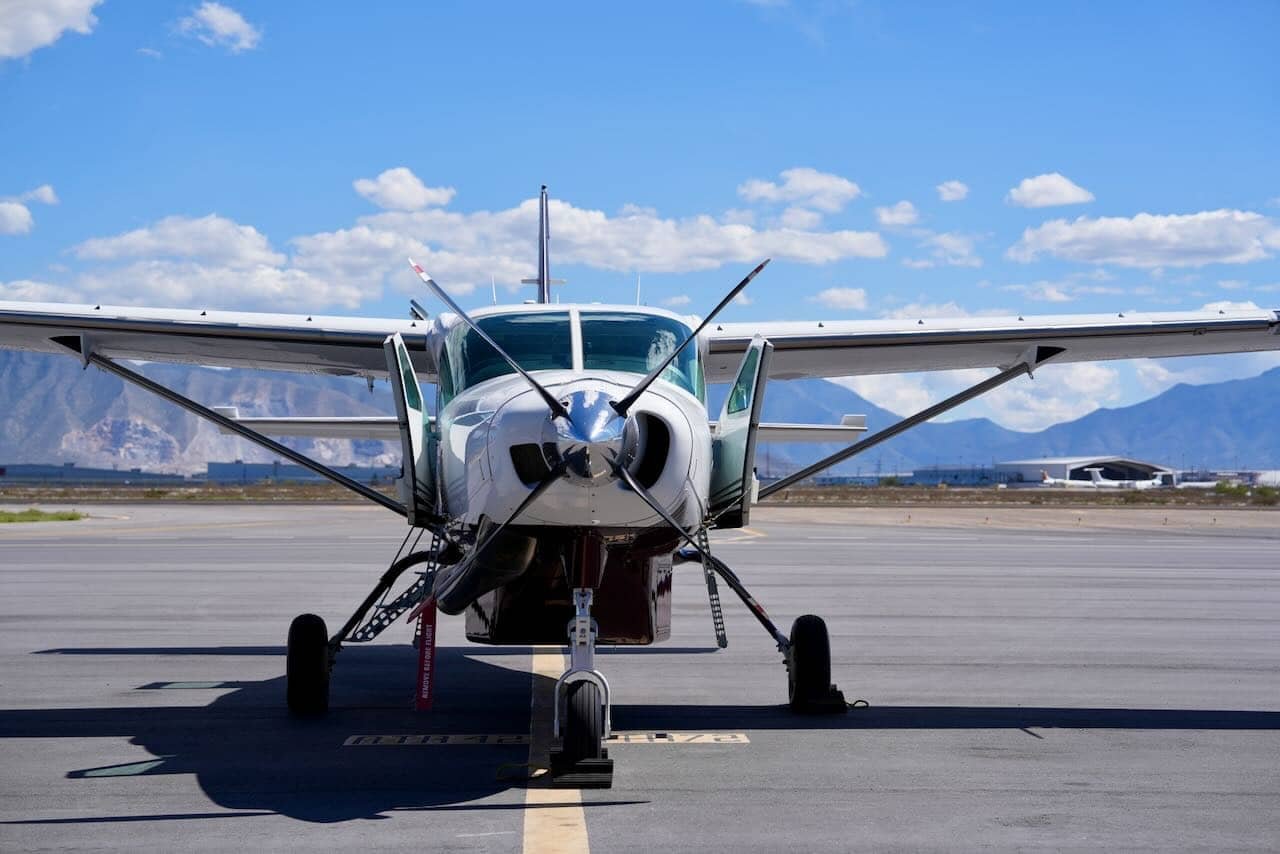
Driven by the 867-shp Pratt & Whitney PT6A-140 engine and a four-blade constant-speed propeller, the Grand Caravan EX delivers strong short-field performance and high operational reliability.
The engine features a reverse-flow combustion design for foreign object damage (FOD) resistance on unprepared runways, backed by a 3,600-hour TBO and a global MRO network for rapid AOG support.
Fuel Efficiency & Sustainability
On typical short-haul missions of 200–600 nautical miles, the Grand Caravan EX consumes approximately 59 US gallons per hour of Jet-A. Compared to the 90–130 GPH required by light jets on identical sectors, this yields a 35–55% reduction in fuel burn and carbon emissions.
For corporate flight departments evaluating ESG metrics and environmental impact, it provides a highly efficient per-seat-mile profile at full passenger capacity.
Short-Field & Backcountry Access
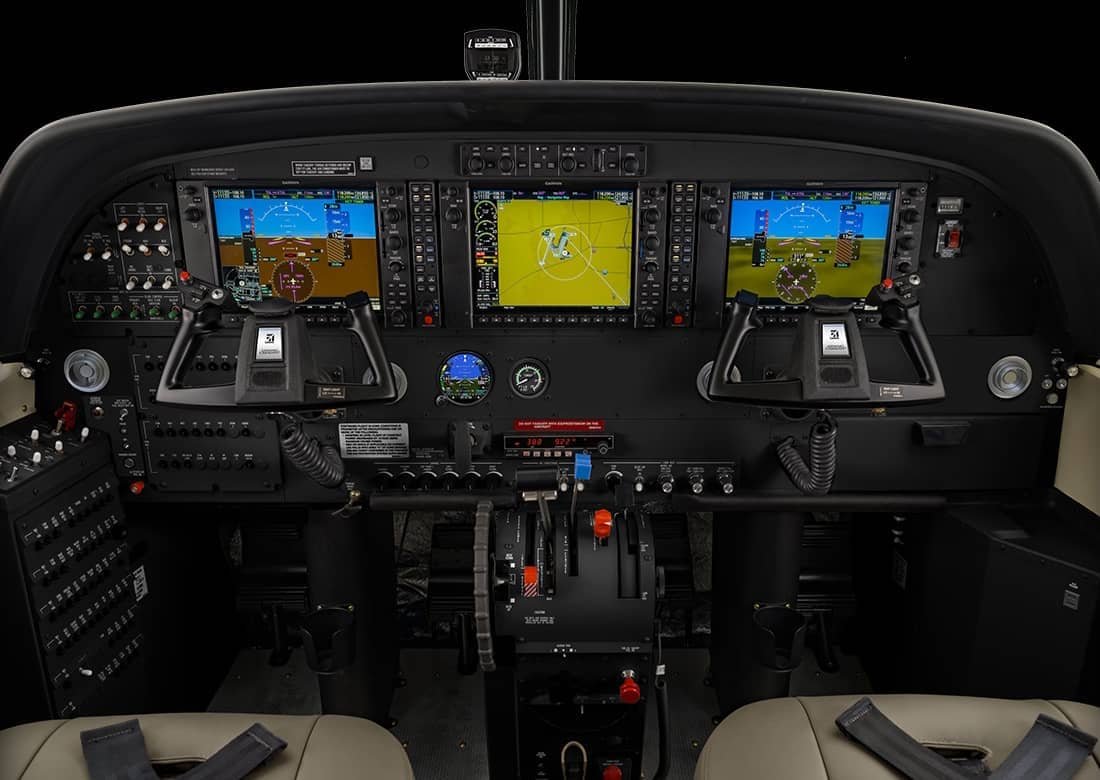
With a takeoff ground roll of approximately 1,399 feet at maximum takeoff weight and a 50-foot obstacle clearance distance of 2,085 feet, the Grand Caravan EX routinely operates from runways under 2,500 feet.
Combined with a 50-foot obstacle landing distance of 1,740 feet, it reliably serves unpaved, gravel, grass, and amphibious floatplane bases across remote island, backcountry, and bush destinations.
Cessna Grand Caravan EX Objective Assessment
Strengths & Considerations
Strengths
- Unmatched Short-Field and Unpaved Runway Access: Certified for operations on grass, gravel, dirt, and water, the Grand Caravan EX provides unparalleled access to unpaved and short-runway destinations. This short-field capability allows charter operators to land passengers directly at remote lodges, safari camps, and expedition sites, bypassing the ground transport times required when using conventional jet alternatives.
- Lower Charter Rates with High Payload Efficiency: Operating at direct costs 30–50% below light jets on sectors under 600 nautical miles, the Grand Caravan EX provides an economical charter solution for cost-conscious corporate departments and group travelers. With a useful load of 3,807 pounds, it delivers high payload capacity without requiring trade-offs between full passenger seating and heavy baggage.
- Exceptional Operational Versatility and Global MRO Support: Backed by a global fleet of over 3,000 airframes across 100 countries and the extensive Pratt & Whitney PT6A service network, the Grand Caravan EX offers reliable MRO support worldwide. Its quick-change cabin flexibility allows multi-role operators to transition efficiently between executive transport, cargo, medical evacuation, and survey configurations.
Considerations
- Speed Penalty on Longer Sectors: At a maximum cruise speed of 175 KTAS, the Grand Caravan EX operates approximately 80–120 knots slower than standard light jets. On routes exceeding 600 nautical miles, this speed differential adds 60–90 minutes to total block time, making the platform best suited for short-haul sectors where access and operating economics take priority over raw speed.
- Non-Pressurized Cabin: Unlike the Pilatus PC-12 NG or Beechcraft King Air series, the Grand Caravan EX features an unpressurized cabin, with typical cruise altitudes held at or below 10,000–12,000 feet. This restricts the aircraft’s ability to overfly severe weather systems and limits high-density-altitude payload performance compared to pressurized turboprop competitors.
REQUEST INSTANT QUOTATION
[jet_search]
Cessna Grand Caravan EX Competitive Landscape
Market Comparison
The two most frequently cited alternatives to the Grand Caravan EX in regional charter discussions are the Pilatus PC-12 NGX (pressurized single-engine turboprop) and the Eclipse 550 (Very Light Jet). The following table provides a direct operational comparison across the metrics that matter most to charter decision-makers.
| Metric | Cessna Grand Caravan EX | Pilatus PC-12 NGX | Eclipse 550 |
|---|---|---|---|
| Cruise Speed (KTAS) | 175 | 290 | 375 |
| Range (nm, with reserves) | 1,070 | 1,803 | 1,125 |
| Pressurized Cabin | No | Yes (6.0 psi differential) | Yes (6.0 psi differential) |
| Typical Seating | 9 pax | 9 pax | 5 pax |
| Min. Runway Required | ~2,000–2,500 ft | ~2,700 ft | ~3,500–4,000 ft |
| Unpaved Runway Certified | Yes | Yes (gravel kit) | No |
| Payload Capacity | 3,807 lb | 2,998 lb | ~1,100 lb |
| Cargo Door Available | Yes (double, 51 × 51 in) | Yes (single) | No |
| Float / Amphibious Options | Yes | No | No |
| Global Fleet Size | 3,000+ | 1,800+ | ~260 |
| Price Range | From $1,250/hr | From $1,800/hr | From $2,500/hr |
Cessna Grand Caravan EX vs. Pilatus PC-12 NGX
While the Pilatus PC-12 NGX provides higher cruise speeds, a pressurized cabin for high-altitude operations above 20,000 feet, and extended range over 700 nautical miles, it commands a significantly higher charter rate.
For missions where short-field access, cargo door dimensions, payload capacity, and lower cost-per-seat-mile take precedence, the Grand Caravan EX delivers superior operating economics.
Cessna Grand Caravan EX vs. Eclipse 550
The Eclipse 550, while offering jet speed and pressurization at a relatively low charter cost, is fundamentally limited by its 5-passenger maximum, minimal payload, paved-runway-only restriction, and smaller MRO network.
For group travel, expedition logistics, or any operation requiring cargo flexibility, it is not a viable alternative. The Grand Caravan EX’s 3,807 lb payload advantage over the Eclipse is not a marginal difference; it is a different operational category entirely.
FREQUENTLY ASKED QUESTIONS
Cessna Grand Caravan EX Charter Specifications & Booking Essentials
How much does it cost to charter a Cessna Grand Caravan EX?
Expect somewhere between $1,250 and $2,000 per flight hour for a Grand Caravan EX, making it one of the more approachable turboprops in the charter market. The final number moves around based on trip length, the airports involved, and how far the aircraft has to reposition before pickup. It’s a workhorse in the best sense, and that shows up in the price tag.
Submit your route and dates for a firm quote reflecting current fuel and availability rather than a generic estimate.
Are there any empty-leg options for the Cessna Grand Caravan EX?
There are, and they show up often. Because the Grand Caravan EX gets used so heavily for short regional hops and cargo-adjacent missions, operators are frequently repositioning it, which opens the door to one-way empty-leg pricing well below the standard rate. If your dates aren’t set in stone, it’s worth asking what’s currently on the board.
Please, visit our EMPTY-LEG page to check current rates for chartering a Grand Caravan EX.
How many passengers can the Grand Caravan EX carry?
The aircraft is typically configured for up to nine passengers in a charter layout, with utility versions accommodating more in cargo or combi configurations. Exact seating depends on the individual aircraft’s interior, which we confirm with the operator before booking.
What is the range of a Cessna Grand Caravan EX?
The Grand Caravan EX is built for regional and short- to medium-haul missions rather than transcontinental range, with its single PT6A engine and fixed landing gear optimized for reliability on unimproved strips. For an exact range on a specific routing, request a quote and we will match it against the operating aircraft’s certified performance data.
How far in advance do I need to book a Grand Caravan EX charter?
Because the Grand Caravan EX fleet is smaller and more specialized than mainstream jet categories, earlier requests secure better positioning, though same-day and short-notice availability is regularly confirmed through our operator network depending on aircraft location.
How does the Grand Caravan EX compare to other turboprops like the Pilatus PC-12?
Both are single-engine turboprops valued for short-field capability, but the Grand Caravan EX is generally favored for its cargo-door versatility and rough-strip durability, while the PC-12 leans toward a quieter, more cabin-focused experience. We can help you weigh both against your specific mission profile.
Can I bring pets or oversized baggage on a Grand Caravan EX charter?
Yes, the aircraft’s cargo-door design and utility-oriented cabin make it well suited to pets, sporting equipment, and oversized items that would be difficult to load on most cabin-class jets. Confirm specific dimensions and any pet policy directly with the operator when requesting your quote.
Do I need a membership to charter a Cessna Grand Caravan EX?
No membership or jet card is required. Each trip is quoted and booked individually through certified operators, giving corporate flight departments and brokers on-demand access to this aircraft type without a subscription commitment.
What Our Passengers Say
The Proof is in the Flight
Begin Your Journey
Request your Cessna Grand Caravan EX charter quote today
The Cessna Grand Caravan EX remains the most operationally versatile charter platform for regional and remote missions. Whether coordinating multi-leg corporate tours across secondary airfields, positioning expedition teams to remote airstrips, or seeking a cost-efficient, high-payload solution for group transfers, this platform delivers capability where jet alternatives are restricted.
Our charter specialists partner with a network of FAR Part 135-certified Grand Caravan EX operators across North America, the Caribbean, Africa, and Southeast Asia. We align your mission profile—runway constraints, payload requirements, schedule, and budget—with the optimal aircraft configuration, delivering itemized quotes within two hours. One-way positioning, empty legs, and multi-sector block rates are available for flexible itineraries.
Request a Grand Caravan EX charter quote by providing your departure point, destination, travel date, passenger count, and cargo requirements.
REQUEST INSTANT QUOTATION
[jet_search]
1 All charter rates quoted on request. Availability subject to operator schedule. Specifications sourced from manufacturer data and may vary by serial number and operator configuration. The rates and price ranges displayed on this website are for informational and estimation purposes only. Actual charter costs may vary based on aircraft availability, operator positioning, seasonal demand, real-time fuel surcharges, landing fees, and specific flight itineraries. InstantPrivateJet.com is an independent marketplace and information resource. We do not own, manage, or operate aircraft. All charters are arranged, quoted, and fulfilled directly by third-party air carriers certified by the FAA (or equivalent civil aviation authorities). Final quotes and legally binding terms will be provided directly by the operating air carrier prior to booking.