
REQUEST INSTANT QUOTATION
[jet_search]
Video courtesy of Bombardier Aerospace
Bombardier Challenger 3500 Charter: Live Pricing & Availability
Bombardier Challenger 3500: Full Specs, Charter Price & Real-Time Availability
Data & Prices Updated September 2026 1
To charter a Bombardier Challenger 3500, you’re booking one of the most capable super-midsize jets flying today, a favorite among corporate flight departments and UHNW travelers who need transcontinental range without the footprint of a heavy jet. Prices range from $5,500 and $6,900 per flight hour. Submit your route and dates here to receive live availability and pricing directly from vetted operators, not a generic quote form.
REQUEST INSTANT QUOTATION
[jet_search]
Every aircraft in our network is matched against current certification status, crew currency, and maintenance records before it’s presented to you. Combined with our global operator relationships, that means faster confirmation on the specific tail you need, with the operational scrutiny UHNW charter demands, wherever your itinerary takes you.
There is a moment, shortly after the doors close and the cabin seals itself from the world, when the Bombardier Challenger 3500 reveals its true character. The ambient noise drops to a whisper, one of the quietest cabins in its class, and the handcrafted interior settles around you like a bespoke suit: precise, considered, and unmistakably purposeful.
This is not merely a business aircraft. It is a carefully engineered statement of intent, built for those who refuse to separate productivity from luxury, or efficiency from elegance.
Introduced as the definitive evolution of Bombardier’s legendary Challenger lineage, the Challenger 3500 redefines the super-midsize category with a cabin altitude as low as 4,850 feet, a figure that borders on the physiologically exceptional, paired with a range of up to 3,400 nautical miles.
That means New York to London with a tailwind, or Los Angeles to Honolulu without compromise. In 2026, when time has become the ultimate luxury, the Challenger 3500 does not ask you to choose between speed and comfort. It simply provides both.
To charter a Bombardier Challenger 3500 is to access what Bombardier describes as the “best cabin in class”, a designation backed by independent market recognition and the unwavering loyalty of the world’s most discerning frequent flyers.
Corporate flight departments trust it for its dispatch reliability. Charter brokers favour it for its versatility. And ultra-high-net-worth individuals return to it again and again for one simple reason: once you have experienced it, every other aircraft in the segment feels like a concession.
Why Choose Us for Private Jet Charter
Every operator in our network holds current FAA Part 135 certification, or the EASA equivalent for European operators, the regulatory standard governing commercial charter operations, crew duty limits, and aircraft maintenance oversight. Combined with ARGUS/Wyvern ratings, this means every aircraft you fly with us has passed both government-mandated safety audits and independent third-party vetting.












Bombardier Challenger 3500 Technical Overview
Key Specifications
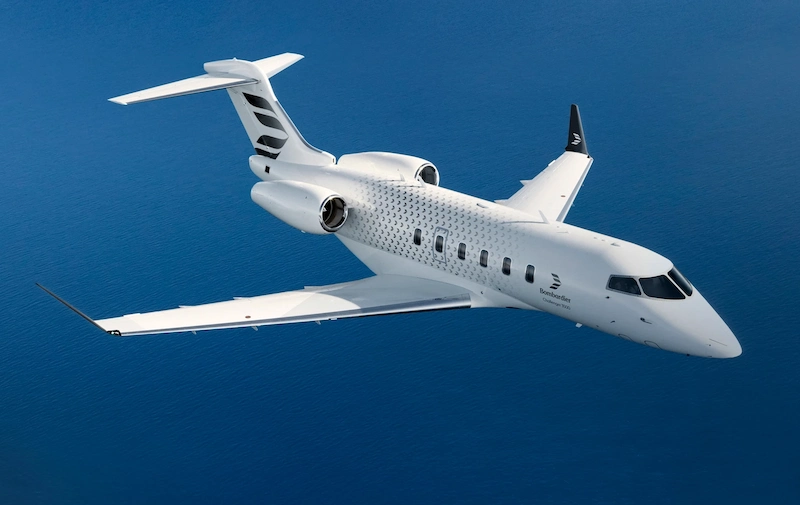
The following data represents the aircraft’s certified, published performance figures as provided by Bombardier Aerospace. All specifications are subject to operational variables including payload, atmospheric conditions, and route configuration.
| Specification | Detail |
|---|---|
| Maximum Range | 3,400 nautical miles (6,297 km) |
| Maximum Cruise Speed | Mach 0.83 |
| Long-Range Cruise Speed | Mach 0.80 |
| Typical Seating Configuration | 9 passengers |
| Cabin Height | 6 ft 1 in (1.85 m) |
| Cabin Width | 7 ft 2 in (2.19 m) |
| Cabin Length | 24 ft 2 in (7.37 m) |
| Maximum Takeoff Weight (MTOW) | 44,000 lb (19,958 kg) |
| Engines | 2 × Honeywell HTF7350 (each 7,528 lbf thrust) |
| Service Ceiling | 45,000 ft |
| Baggage Volume | 106 cu ft (3.0 m³) |
| Cabin Altitude | 4,850 ft at FL410 (class-leading) |
| Takeoff Distance (MTOW, ISA, SL) | 5,360 ft (1,634 m) |
Bombardier Challenger 3500 Interior & Amenities
The Cabin Experience
Step through the door of the Bombardier Challenger 3500 and you enter one of the most acoustically refined environments in business aviation.
Bombardier has invested significantly in active noise suppression technology and enhanced cabin insulation, resulting in a noise level that is measurably quieter than the previous Challenger 350 — itself already regarded as a benchmark in the super-midsize segment. The result is a space where conversation flows naturally, focus comes effortlessly, and rest arrives without resistance.
Interior Layout & Comfort
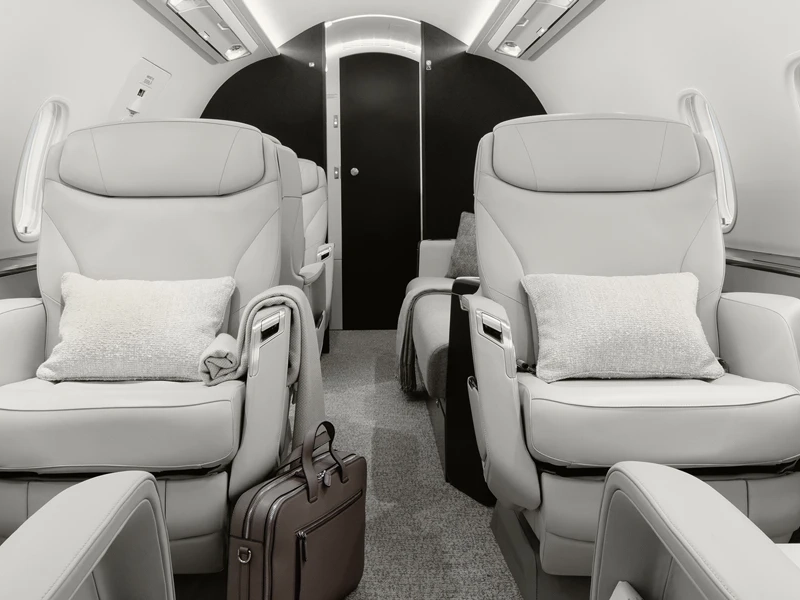
The standard interior accommodates 9 passengers in a club seating arrangement, with 4 individual club seats forward and a 3-seat divan aft — a configuration that has been refined over decades of real-world operator feedback.
Every seat is Bombardier’s patented Nuage design, the first time this Global 7500-derived architecture has appeared outside the Global family. Its zero-gravity recline and holistic seat structure reduce lower-back pressure on long sectors, setting a genuine benchmark for super-midsize comfort.
The full stand-up cabin, measuring 6 ft 1 in in height, allows genuine freedom of movement throughout the flight.

Connectivity & Technology
The Challenger 3500 is equipped with Ka-band satellite WiFi as a standard feature — a significant upgrade from prior generations and a direct response to the connectivity demands of the modern executive traveller.
The system delivers broadband-class speeds capable of supporting video conferencing, real-time data access, and uninterrupted cloud-based workflows at altitude.
Complementing this, the aircraft features USB-A and USB-C charging ports at every seat position, a 40-inch HD monitor for presentations or in-flight entertainment, and a high-definition infotainment system that can be controlled individually via smart device integration.
The cabin altitude of just 4,850 feet at FL410 — equivalent to conditions found in some of the world’s most liveable cities — is among the lowest in its segment.
Passengers consistently report arriving at their destination feeling markedly more alert and less fatigued than on comparable aircraft, a physiological advantage that translates directly into business performance.
Challenger 3500 Baggage Hold & Galley
The aft lavatory features an enclosed, private design with enhanced finishes and thoughtful storage, reflecting a level of attention normally associated with large-cabin aircraft.
A spacious galley — positioned at the forward entry — provides dedicated workspace for catering and beverages, with ample storage for full meal service on transcontinental sectors.
The aircraft’s 106 cu ft baggage compartment, fully accessible in-flight through an internal connection on select configurations, handles the luggage requirements of a full group with ease.

REQUEST INSTANT QUOTATION
[jet_search]
Bombardier Challenger 3500 Powerplant & Avionics
Performance & Engineering
Propulsion: Honeywell HTF7350
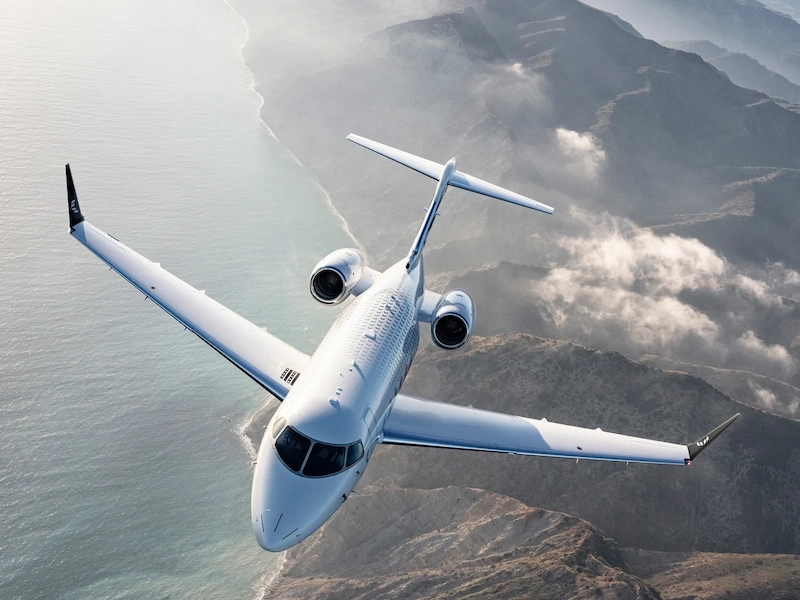
The Challenger 3500 is powered by twin Honeywell HTF7350 turbofan engines, each producing 7,528 pounds of thrust.
These powerplants represent a significant advancement over the HTF7000-series units found on earlier Challenger variants, delivering improved fuel burn efficiency, enhanced hot-and-high performance, and a wider operational envelope.
The engines are certified for operation on Sustainable Aviation Fuel (SAF), supporting blends of up to 50% SAF in compliance with ASTM D7566 standards — a meaningful concession to corporate sustainability mandates and ESG reporting requirements that have become increasingly relevant to high ticket charter clients in 2026.
The combination of improved thrust-to-weight ratio and aerodynamic refinements inherited from the Challenger 350’s proven airframe gives the 3500 its short-field capability — able to operate from runways as short as those serving smaller regional airports — without sacrificing intercontinental ambition.
Sustainability & SAF Compatibility
As ESG criteria become embedded in corporate procurement and travel policies, the Challenger 3500’s SAF compatibility positions it as a responsible choice for organisations with net-zero commitments.
Bombardier has been an active participant in industry-wide SAF adoption initiatives, and the Challenger 3500 platform is ready to benefit from broader SAF availability as the fuel infrastructure matures across key aviation hubs globally.
Flight Deck – Avionics
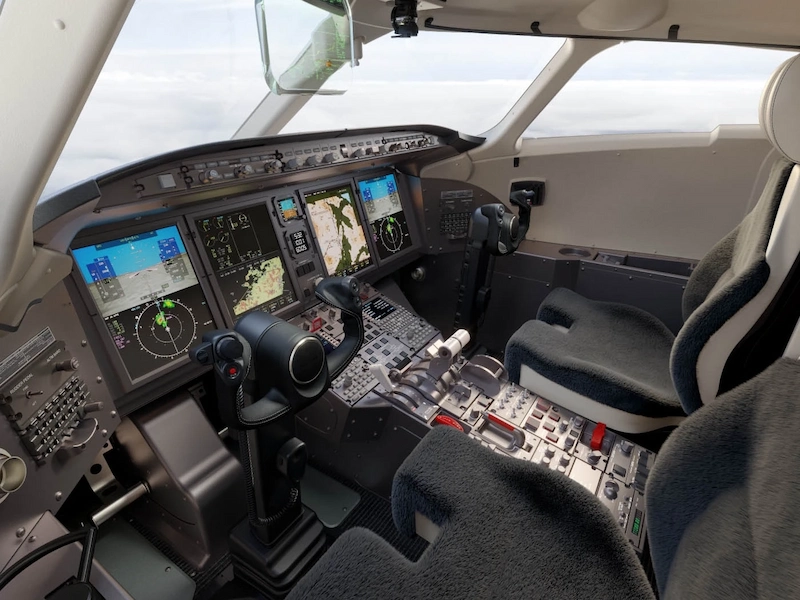
At the heart of the Challenger 3500’s operational excellence sits the Garmin G5000 integrated flight deck, a next-generation avionics suite that represents a decisive upgrade over the Rockwell Collins Pro Line 21 system of its predecessor.
The G5000 delivers three large-format, high-resolution touchscreen displays and an intuitive interface that reduces crew workload, improves situational awareness, and enables more precise flight path management.
The system integrates seamlessly with synthetic vision technology (SVT), WAAS-enabled GPS navigation, and a comprehensive suite of datalink weather services.
Pilots who transition to the G5000 consistently report improved operational confidence in complex airspace and adverse weather, a factor that contributes directly to the aircraft’s exceptional dispatch reliability.
For charter operators, reliability is not a luxury, it is a contractual obligation to their clients and a core component of their reputation. The Challenger 3500 is designed to consistently meet that standard, providing passengers with maximum safety and complete peace of mind.
Bombardier Challenger 3500 Objective Assessment
Strengths & Considerations
At this level of investment, transparency is not merely a courtesy; it is a professional obligation. The following balanced evaluation is designed to charter clients in making fully informed decisions.
Strengths
- Class-Leading Cabin Comfort and Noise Suppression: The Challenger 3500 sets the benchmark in the super-midsize segment for cabin livability. Its low cabin altitude of 4,850 feet, industry-recognised noise suppression, and exceptional width (7 ft 2 in) consistently exceed what rival manufacturers offer at equivalent price points. For passenger wellbeing on sectors of 4–7 hours, no competing platform in this category delivers a meaningfully superior experience.
- Outstanding Short-Field and Hot-and-High Performance: With a takeoff distance of approximately 5,360 feet at MTOW under sea-level standard conditions, the Challenger 3500 accesses a significantly wider range of airports than many rivals — including challenging high-altitude destinations in Colorado, Mexico, and the Alps. This operational versatility directly expands the destinations accessible without diverting to alternate, larger airports.
- Modern Avionics and Connectivity Suite: The transition to the Garmin G5000 flight deck and the inclusion of standard Ka-band WiFi address two of the most cited limitations of the outgoing Challenger 350. In a market where technology obsolescence is a genuine residual-value concern, the Challenger 3500’s avionics and connectivity suite ensures every charter feels current, no outdated cabin technology working against the experience you’re paying for.
Considerations
- Range Limitation vs. Large-Cabin Competitors: At a maximum range of 3,400 nautical miles, the Challenger 3500 is optimised for transatlantic sectors with favourable winds, but it is not a true non-stop New York–London aircraft in all loading scenarios. Clients requiring consistent, unrestricted transatlantic or transpacific range without payload compromise should evaluate large-cabin alternatives such as the Bombardier Global 5500 or the Gulfstream G600, which offer meaningfully extended reach.
- Cabin Length Relative to Larger-Cabin Rivals: While the cabin width and height are genuinely impressive, the Challenger 3500’s cabin length of 24 ft 2 in is inherently constrained by the super-midsize platform. Compared to large-cabin jets offering 30–45 feet of cabin length, groups of 8–9 passengers on long sectors will find the available floor space more intimate. This is an architectural reality of the category, not a deficiency exclusive to Bombardier — but it warrants consideration for large-delegation travel.
REQUEST INSTANT QUOTATION
[jet_search]
Bombardier Challenger 3500 Competitive Landscape
Market Comparison
The super-midsize category is genuinely competitive in 2026, and discerning clients deserve an honest comparative framework. The two closest rivals to the Bombardier Challenger 3500 are the Cessna Citation Latitude and the Gulfstream G300.
| Specification | Bombardier Challenger 3500 | Cessna Citation Latitude | Gulfstream G300 |
|---|---|---|---|
| Maximum Range | 3,400 nm | 2,700 nm | 3,600 nm |
| Max Cruise Speed | Mach 0.83 | Mach 0.80 | Mach 0.85 |
| Cabin Height | 6 ft 1 in (1.85 m) | 6 ft 0 in (1.83 m) | 6 ft 1 in (1.85 m) |
| Cabin Width | 7 ft 2 in (2.19 m) | 6 ft 5 in (1.96 m) | 6 ft 11 in (2.11 m) |
| Cabin Altitude at FL450 | ~4,850 ft | ~5,950 ft | ~4,800 ft |
| Typical Seating | 9 passengers | 9 passengers | 10 passengers |
| SAF Compatible | Yes (up to 50%) | Yes | Yes |
| Price Range | From $5,500/hr | From $4,000/hr | From $6,000/hr |
Bombardier Challenger 3500 vs. Cessna Citation Latitude
Choosing between the Bombardier Challenger 3500 and the Cessna Citation Latitude ultimately depends on how far you need to fly and how much cabin space matters to you.
The Challenger 3500 sits a class above in raw performance, covering up to 3,400 nautical miles at Mach 0.83, which opens up nonstop transcontinental or short transatlantic routes. The Citation Latitude, a dedicated midsize aircraft, tops out at 2,700 nautical miles and Mach 0.80, making it a better match for regional trips and shorter business hops rather than long-haul missions.
Inside, the gap widens further: the Challenger’s 7 ft 2 in cabin gives passengers considerably more elbow room than the Latitude’s narrower 6 ft 5 in width, though the Latitude holds its own with a comparatively low cabin altitude for added comfort at cruise. Both jets accommodate 9 passengers and run on sustainable aviation fuel.
Operating costs track the performance difference too, with the Latitude chartering from around $4,000 per hour compared to roughly $5,500 per hour for the Challenger 3500.
Bottom line: go Challenger for range and space, go Latitude for value on shorter trips.
Bombardier Challenger 3500 vs. Gulfstream G300
Bombardier Challenger 3500 vs. Gulfstream G300 comes down to a trade-off between operating cost and outright capability.
The Gulfstream G300 leads on range and speed, reaching 3,600 nautical miles at up to Mach 0.85, enough for true transatlantic missions, while the Challenger 3500 covers 3,400 nautical miles at Mach 0.83, still solid for transcontinental and short international legs.
Cabin dimensions favor the G300 slightly in width at 6 ft 11 in versus the Challenger’s 7 ft 2 in, though the Challenger actually edges it out here, giving passengers a touch more shoulder room despite the G300’s larger overall class positioning.
The G300 also seats up to 10 passengers against the Challenger’s 9, useful for larger groups or two-zone cabin layouts.
Cabin altitude is close between the two, with the G300 marginally lower at around 4,800 ft versus the Challenger’s 4,850 ft. Both are SAF compatible.
Cost tells the rest of the story: the Challenger 3500 starts from about $5,500 per hour, while the G300 starts from roughly $6,000 per hour, reflecting its larger cabin and extended range.
For pure efficiency, the Challenger wins; for capacity and reach, the G300 pulls ahead.
FREQUENTLY ASKED QUESTIONS
Challenger 3500 Charter Specifications & Booking Essentials
How much does it cost to charter a Bombardier Challenger 3500?
Chartering a Bombardier Challenger 3500 typically costs between $5,500 and $6,900 per flight hour. This super-midsize jet’s rate reflects its Nuage seating, transcontinental range, and premium cabin technology. Final pricing depends on trip length, routing, seasonal demand, and operator availability, so request a personalized quote for exact, all-inclusive pricing on your route.
Is luxury catering included in the Challenger 3500 charter price?
Standard catering, such as premium snacks, beverages, and light refreshments, is typically included in the base hourly rate. Multi-course chef-prepared meals, specific dietary programs, or requests from named restaurants are usually arranged as an add-on and quoted separately based on your preferences and flight duration.
Are there any empty-leg options for the Challenger 3500?
Yes. Empty-leg flights occur when a Challenger 3500 repositions after dropping off passengers, and these one-way segments are often available at a meaningful discount off standard charter rates. Availability changes daily and is tied to fixed routes and departure windows, so flexible travelers should ask their broker to flag current Challenger 3500 empty legs.
How many passengers can the Challenger 3500 carry?
The Challenger 3500 is configured to seat up to 9 passengers in an executive configuration for optimal comfort on longer legs. Exact seating varies by individual aircraft, and we confirm the specific cabin configuration before you book.
What is the range of the Challenger 3500, and which routes can it fly nonstop?
The Challenger 3500 is built for transcontinental missions, capable of connecting most major city pairs across North America and reaching into Europe or South America on favorable routings without a fuel stop. We recommend confirming exact range performance against your specific payload and route with the operator at quote stage.
How far in advance do I need to book a Challenger 3500 charter?
Availability can move quickly given demand for this aircraft class, so earlier requests give access to a wider set of tail options. That said, our operator network is regularly able to confirm short-notice charters, and same-day availability checks are handled directly through this page.
How does the Challenger 3500 compare to other super-midsize jets?
The Challenger 3500 is frequently compared against aircraft like the Citation Longitude and Praetor 600 for its combination of cabin comfort, range, and reliability. Its Nuage seating and cabin altitude performance are commonly cited differentiators, though the right aircraft for your mission depends on route length and passenger count — our team can walk you through the tradeoffs.
Can I bring pets or extra luggage on a Challenger 3500 charter?
Most operators accommodate pets in the cabin on the Challenger 3500, subject to the individual aircraft’s pet policy and destination import regulations. Baggage capacity is generous for this class, but oversized items should be flagged when requesting your quote so the operator can confirm cargo hold compatibility.
Do I need a membership to charter a Challenger 3500?
No membership or jet card is required. Charter access to the Challenger 3500 is available on a per-trip basis through our operator network, with pricing and availability confirmed for your specific dates and route.
What Our Passengers Say
The Proof is in the Flight
Begin Your Journey
Request your Bombardier Challenger 3500 charter quote today
The Bombardier Challenger 3500 is not simply an aircraft you charter, it is a capability you deploy. Whether you require a single sector from New York to Miami, a transatlantic crossing to Geneva for a board meeting, or a multi-leg itinerary across North America for a leadership conference, the Challenger 3500 delivers with a consistency and elegance that transforms business travel from a necessity into a genuine competitive advantage.
If you are evaluating the Challenger 3500 for charter, our team of dedicated aviation consultants can source the ideal aircraft, verify its maintenance status, and structure an itinerary tailored precisely to your schedule and expectations within hours.
REQUEST INSTANT QUOTATION
[jet_search]
1 All charter rates quoted on request. Availability subject to operator schedule. Specifications sourced from manufacturer data and may vary by serial number and operator configuration. The rates and price ranges displayed on this website are for informational and estimation purposes only. Actual charter costs may vary based on aircraft availability, operator positioning, seasonal demand, real-time fuel surcharges, landing fees, and specific flight itineraries. InstantPrivateJet.com is an independent marketplace and information resource. We do not own, manage, or operate aircraft. All charters are arranged, quoted, and fulfilled directly by third-party air carriers certified by the FAA (or equivalent civil aviation authorities). Final quotes and legally binding terms will be provided directly by the operating air carrier prior to booking.