
REQUEST INSTANT QUOTATION
[jet_search]
Video courtesy of Cirrus Aircraft
Cirrus Vision Jet SF50 Charter- Rates, Routes & Booking
The World’s Only Single-Engine Personal Jet: Cirrus Vision Jet SF50 Charter Price, Specs & Availibility
Data & Prices Updated September 2026 1
Charter a Cirrus Vision Jet SF50 for point-to-point trips where a full-size cabin isn’t required but jet-level speed and reliability are. Prices range from $1,900 to $3,250 per hour. Submit your route below and our desk returns aircraft availability and an all-in quote for this specific airframe, not a category estimate.
REQUEST INSTANT QUOTATION
[jet_search]
As the most widely produced single-engine light jet in operation, the SF50 is supported by a deep, geographically distributed operator network, meaning positioning delays are rare even on short notice. Every operator in our SF50 charter pool holds current FAA Part 135 certification, with maintenance records and crew currency verified before any quote is issued.
The Cirrus Vision Jet SF50 charter represents a paradigm shift in private aviation, offering ultra-high-net-worth individuals, corporate flight departments, and luxury charter brokers access to a category-defining aircraft unlike anything else in the sky.
As the world’s first and only FAA-certified single-engine personal jet, the SF50 combines the operating economics of a turboprop with the prestige and performance of a true jet, making it the most sought-after light jet charter option for short-to-medium stage travel in 2026.
Whether you are connecting city pairs separated by geography or seeking a more intimate and responsive flying experience, chartering a Cirrus Vision Jet places you aboard an aircraft engineered to the highest standards of safety, design, and technological sophistication.
Step aboard the SF50 and the first thing you register is the silence, not the absence of sound, but its quality. The single Williams FJ33-5A turbofan engine, mounted high on the aft fuselage, eliminates the cabin-forward noise intrusion that plagues traditional twin-engine configurations.
What remains is a hushed, pressurized environment wrapped in panoramic windows that pour natural light across hand-stitched leather seats and precision-finished interior panels. The Vision Jet is not merely a transport mechanism; it is an expression of considered design philosophy, where every material choice, from the tactile quality of the instrument surrounds to the curvature of the club seating, communicates that this aircraft was built with an intimate understanding of what discerning travelers actually want from private aviation.
Why Choose Us for Private Jet Charter
Every operator in our network holds current FAA Part 135 certification, or the EASA equivalent for European operators, the regulatory standard governing commercial charter operations, crew duty limits, and aircraft maintenance oversight. Combined with ARGUS/Wyvern ratings, this means every aircraft you fly with us has passed both government-mandated safety audits and independent third-party vetting.












Cirrus Vision Jet SF50 Technical Overview
Key Specifications

Freedom, in the context of private aviation, is measured in nautical miles, flexibility, and the ability to access airports the airliners cannot reach. The Cirrus SF50 excels precisely here — its ability to operate from shorter runways opens a geography of destination possibilities that larger jets simply cannot match, connecting private terminals, regional strips, and mountain-elevation airports with equal composure. The Cirrus Aircraft brand, long synonymous with innovation and the landmark Cirrus Airframe Parachute System (CAPS) technology carried over into the SF50, carries an authority that resonates beyond enthusiast circles — it speaks to a rigorous, safety-first engineering culture that has set new benchmarks for the entire general aviation industry.
| Specification | Detail |
|---|---|
| Maximum Range | 1,200 nautical miles (with reserves) |
| Maximum Cruise Speed | 311 KTAS (Mach 0.47) |
| Typical Seating Configuration | 7 passengers |
| Cabin Height | 3 ft 11 in (47 in / 1.19 m) |
| Cabin Width | 4 ft 11 in (59 in / 1.50 m) |
| Maximum Takeoff Weight (MTOW) | 6,000 lbs (2,722 kg) |
| Service Ceiling | 28,000 ft |
| Takeoff Distance | Approximately 2,036 ft (621 m) |
| Powerplant | Williams International FJ33-5A (1,800 lbf) |
REQUEST INSTANT QUOTATION
[jet_search]
ICirrus Vision Jet SF50 nterior & Amenities
The Cabin Experience
An Interior That Reframes What a Small Jet Can Be
Interior Layout & Seating
The SF50 cabin is a study in intelligent restraint. At 59 inches wide and 47 inches tall, the dimensions are honest, this is a Very Light Jet, not a midsize pretender, but Cirrus has deployed every inch with architectural discipline.
The signature panoramic windows, unusually tall and wide for the aircraft’s class, transform the cabin into an elevated observatory. At cruise altitude, passengers look out across an uninterrupted horizon, a visual dividend that no first-class airline seat can match at any price.
Executive leather seating with adjustable headrests and lumbar support is standard across charter-configured aircraft.
The cabin environment benefits directly from the overhead-mounted engine design: vibration is minimized, noise levels are among the lowest in the VLJ segment, and the center fuselage remains free of mechanical intrusion.
Cabin altitude at maximum ceiling is maintained comfortably, reducing passenger fatigue on two-hour regional stages.

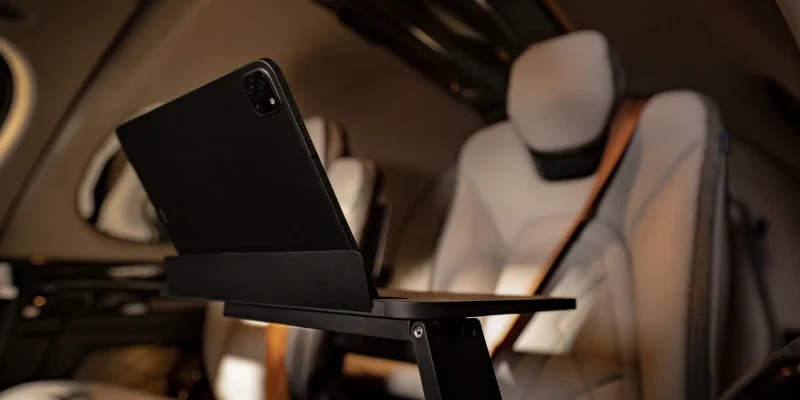
Cirrus Vision Jet SF50 Connectivity & In-Flight Systems
Charter-configured SF50s typically offer in-flight connectivity suitable for messaging and document review — appropriate to the mission profiles for which this aircraft excels. While the SF50 does not carry the Ka-band satellite infrastructure of ultra-long-range cabins, its connectivity solutions are sufficient for the regional executive traveler.
Cirrus Vision Jet SF50 Galley & Baggage
The forward galley area accommodates chilled beverages, light catering, and essential refreshments.
Baggage capacity stands at 35 cubic feet across the aft compartment — generous for a personal jet, adequate for weekend or short-business-trip packing standards.

Cirrus Vision Jet SF50 Powerplant & Avionics
Performance & Engineering
Propulsion: Williams International FJ33-5A
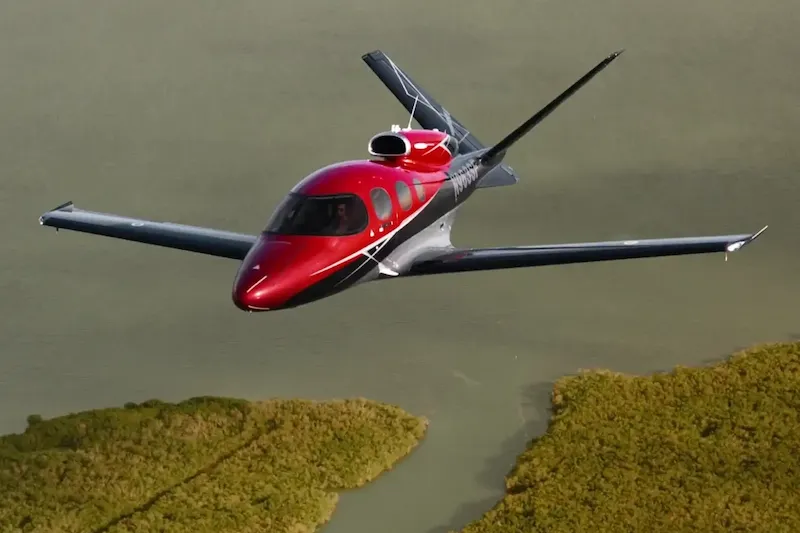
The SF50 is powered by a single Williams International FJ33-5A turbofan engine, rated at 1,800 pounds of force and mounted above the fuselage in a distinctive overhead nacelle configuration.
This placement is not merely aesthetic: it elevates the engine intake well above foreign object debris on unimproved or shorter runways, expands the aircraft’s operational envelope, and contributes materially to cabin noise reduction.
The FJ33-5A is a proven powerplant with an established maintenance and parts ecosystem, an important consideration for operators who charter or own in markets with varied MRO infrastructure.
Sustainability & SAF Compatibility
The Williams FJ33-5A engine is certified for operation on approved blends of Sustainable Aviation Fuel (SAF), letting charter clients reduce their per-flight carbon footprint without sacrificing performance.
With private aviation under growing environmental scrutiny in 2026, offering SAF-blended flights positions operators at the intersection of luxury and responsibility for ESG-conscious travelers.
Flight Deck – Avionics
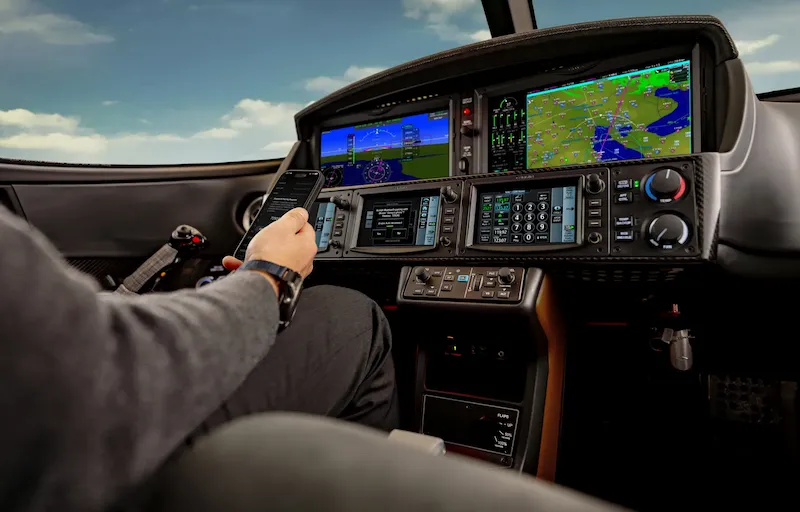
The cockpit is governed by the Garmin G3000 Perspective Touch+ avionics suite, a fully integrated glass cockpit with dual touchscreen controllers, synthetic vision, ADS-B In/Out, and WAAS-enabled GPS approaches.
The system reduces pilot workload through intuitive menu architecture, making the SF50 accessible to single-pilot IFR operations without sacrificing situational awareness.
The autothrottle system, rare in this weight class, adds an additional layer of precision and safety margin during approach and departure phases.
Safety: The CAPS Advantage
Perhaps the most consequential engineering decision on the SF50 is the inclusion of the Cirrus Airframe Parachute System (CAPS), a ballistic whole-aircraft parachute deployable by a single handle pull, certifiable for use up to the aircraft’s maximum cruise speed. CAPS has saved lives across Cirrus’s piston fleet and its inclusion on a jet-powered aircraft is a decisive differentiator for owner-pilots and safety-conscious charterers.
It is an acknowledgment that engineering humility — designing for the worst outcome — is itself a mark of sophistication.
Cirrus Vision Jet SF50 Objective Assessment
Strengths & Considerations
Strengths
- Exceptional short-field performance: With a takeoff roll of approximately 2,036 feet, the SF50 opens access to smaller regional airports and private airstrips unreachable by midsize or heavy jets — a genuine operational advantage for point-to-point flexibility.
- Best-in-class safety architecture: The integration of the Cirrus Airframe Parachute System (CAPS) and a Garmin Autothrottle represents a safety standard unmatched in the VLJ segment, a compelling argument for risk-conscious principals and corporate flight departments.
- Operating economics: The single-engine configuration and lightweight MTOW translate into fuel burn and maintenance costs substantially below those of twin-engine VLJs and light jets, making short-stage charter economics genuinely competitive.
Considerations
- Range limitations vs. the broader light jet market: At approximately 1,200 nautical miles, the SF50’s range is suited to regional and intra-continental city pairs. Clients requiring transatlantic capability or coast-to-coast US routing without a technical stop will need to consider a larger platform.
- Single-engine certification constraints: While CAPS mitigates much of the safety concern, certain international regulatory authorities and corporate flight department policies restrict or discourage single-engine turbine operations over extended overwater or remote terrain segments — a factor relevant to specific routing requirements.
Cirrus Vision Jet SF50 Competitive Landscape
Market Comparison
Understanding where the Cirrus Vision Jet SF50 sits within its competitive landscape helps clients and brokers identify the right platform for the mission at hand.
| Specification | Cirrus Vision Jet SF50 | HondaJet Elite II | Embraer Phenom 100EV |
|---|---|---|---|
| Max Range | 1,200 nm | 1,437 nm | 1,178 nm |
| Max Cruise Speed | 311 KTAS | 422 KTAS | 400 KTAS |
| Typical Seating | Up to 7 pax | Up to 5 pax | Up to 7 pax |
| Cabin Width | 4 ft 11 in | 5 ft 0 in | 4 ft 11 in |
| Cabin Height | 3 ft 11 in | 4 ft 10 in | 4 ft 7 in |
| MTOW | 6,000 lbs | 10,600 lbs | 10,582 lbs |
| Service Ceiling | 28,000 ft | 43,000 ft | 41,000 ft |
| Whole-Aircraft Parachute | Yes (CAPS) | No | No |
| SAF Compatible | Yes | Yes | Yes |
| Price range | From $1,900/hr | From $3,200/hr | From $2,500/hr |
| Best For | Short-field access, regional agility, safety-first principals | Extended regional range, twin-engine certification requirements | Balanced VLJ performance with global brand support network |
Cirrus Vision Jet SF50 – Vs – Honda HA-420 HondaJet Elite II
The HondaJet Elite II is the SF50’s most direct and credible rival in the VLJ segment. With twin GE Honda HF120 engines, a range of approximately 1,437 nautical miles, and a maximum cruise speed of 422 KTAS, it outperforms the SF50 meaningfully on range and speed.
The HondaJet cabin is marginally taller and benefits from twin-engine certification, expanding its regulatory and operational reach. For clients prioritizing range and twin-engine assurance, the HondaJet Elite II is the natural next step up; for those where short-field access and operating economy are paramount, the SF50 retains its edge.
Cirrus Vision Jet SF50 – Vs – Embraer Phenom 100EV
The Embraer Phenom 100EV offers a twin-engine configuration, a 1,178-nautical-mile range, and a best cruise of 400 KTAS, making it faster but with a similar range ceiling. Its cabin, at 4 ft 11 in wide and 4 ft 7 in tall, is comparable to the SF50 in volume.
The Phenom 100EV benefits from Embraer’s global service network and the PRODIGY Touch flight deck based on Garmin G1000NXi avionics.
Where the SF50 wins is on runway performance, the CAPS safety system, and the emotive distinctiveness of its design and ownership community. The Phenom 100EV is a refined choice; the Vision Jet is a statement one.
FREQUENTLY ASKED QUESTIONS
Vision Jet SF50 Charter Specifications & Booking Essentials
How much does it cost to charter a Cirrus Vision Jet SF50?
The Cirrus Vision Jet SF50 is the most affordable jet you can charter, with hourly rates typically ranging from $1,900 to $3,250 per hour. As the first single-engine personal jet on the market, it’s ideal for shorter regional trips (up to roughly 1,000–1,200 nautical miles) for 3–5 passengers, although it can seat a total of 7 passengers, depending on the seating configuration, and it’s especially well-suited to accessing smaller airports close to your final destination. Get a personalized quote to see how the Vision Jet SF50 compares for your specific route.
Is luxury catering included in the Vision Jet SF50 charter price?
Given the Vision Jet’s compact single-engine cabin, standard charter pricing does not include catering by default. However, we can absolutely arrange curated snacks, beverages, and light gourmet options suited to the aircraft’s size and typical shorter flight times. Let us know your preferences in advance and we’ll include catering in your quoted trip cost.
Are there any empty-leg options for the Vision Jet SF50?
Yes, the Vision Jet SF50 is one of the most-delivered light aircraft in production, and with a growing charter fleet, empty-leg opportunities surface regularly, particularly on popular regional and leisure routes. These one-way repositioning flights can offer substantial discounts versus standard charter rates.
Please visit our EMPTY-LEG page to check current rates for chartering a Vision Jet SF50.
How many passengers can the SF50 carry?
The Vision Jet SF50 is configured to carry up to seven occupants depending on the specific aircraft’s interior layout and operator configuration, making it well suited to small executive groups or family travel. Passenger capacity for your assigned aircraft is confirmed at the time of quote.
What is the range of the Cirrus Vision Jet SF50?
The SF50 is designed for regional and medium-range missions rather than transcontinental nonstops, with published range figures varying by payload and reserve fuel policy. For a specific route, our desk verifies whether the aircraft can fly it nonstop or requires a technical stop before confirming your itinerary.
How far in advance do I need to book an SF50 charter?
Because the SF50 fleet is widely distributed across regional operators, same-day and next-day availability is common for shorter sectors. For peak travel periods or less common routings, booking 48 to 72 hours ahead improves aircraft choice and pricing.
How does the SF50 compare to other light jets like the HondaJet or Phenom 100?
The Vision Jet SF50 is unique as the only certified single-engine light jet on the market, giving it a distinct operating cost profile compared to twin-engine light jets such as the HondaJet Elite or Phenom 100. Cabin size and range are broadly comparable across the class; our team can walk through the tradeoffs against alternatives before you commit to a specific model.
Can I bring pets or extra luggage on an SF50 charter?
Pets are generally accommodated on the SF50 subject to operator policy and cabin space, and should be flagged when requesting your quote. Baggage capacity is more limited than in midsize or heavy jets, so oversized items should be confirmed with the operator in advance to avoid day-of surprises.
Do I need a membership or jet card to charter an SF50?
No membership or jet card is required. Charters are arranged on an on-demand basis, with each request matched to a currently certificated operator and quoted individually for your specific trip.
What Our Passengers Say
The Proof is in the Flight
Begin Your Journey
Request your Cirrus Vision Jet SF50 charter quote today
The Cirrus Vision Jet SF50 is not simply an aircraft, it is a philosophy of travel made airborne: direct, precise, safe, and free from the compromises of commercial aviation. Our aviation advisors work exclusively with ultra-high-net-worth principals, family offices, and corporate flight departments to match the right aircraft to the right purpose, with complete discretion and no obligation.
REQUEST INSTANT QUOTATION
[jet_search]
1 All charter rates quoted on request. Availability subject to operator schedule. Specifications sourced from manufacturer data and may vary by serial number and operator configuration. The rates and price ranges displayed on this website are for informational and estimation purposes only. Actual charter costs may vary based on aircraft availability, operator positioning, seasonal demand, real-time fuel surcharges, landing fees, and specific flight itineraries. InstantPrivateJet.com is an independent marketplace and information resource. We do not own, manage, or operate aircraft. All charters are arranged, quoted, and fulfilled directly by third-party air carriers certified by the FAA (or equivalent civil aviation authorities). Final quotes and legally binding terms will be provided directly by the operating air carrier prior to booking.