
REQUEST INSTANT QUOTATION
[jet_search]
Video courtesy of Hondajet.com
Charter HondaJet Elite II – Rates, Routes & Booking
Precision Reimagined: HondaJet Elite II Charter Price, Specs & Availability
Data & Prices Updated September 2026 1
Charter a HondaJet Elite II for point-to-point trips where cabin efficiency and runway flexibility matter as much as schedule. This page connects you directly to verified operators flying this specific airframe, so you can request live availability and an hourly rate quote for your exact route today. Prices range from $3,200 to $4,500 per flight hour.
REQUEST INSTANT QUOTATION
[jet_search]
Every operator in our network is vetted for current certification, maintenance records, and crew currency before a quote reaches you. Requests are typically answered within 2 hours, with access to Elite II airframes positioned across multiple regions, giving flight departments and brokers a dependable option even on short notice, without the delay of contacting operators one by one.
Step aboard the HondaJet Elite II and enter a category that Honda’s engineers spent decades perfecting. In 2026, chartering a very light jet means demanding more than mere transportation, it means commanding silence at 43,000 feet, inhaling the faint scent of hand-stitched leather, and watching city lights dissolve beneath wings shaped by aerospace science and Japanese craftsmanship. The HondaJet Elite II delivers precisely that: a cabin that feels borrowed from a much larger aircraft, enveloped in a hush that redefines what entry-level private aviation can sound and feel like.
Honda’s audacious decision to mount its GE Honda HF120 turbofan engines over the wings, rather than at the tail, was not mere showmanship. That unconventional architecture frees the aft fuselage from structural compromise, gifting the Elite II a cabin volume and rear lavatory configuration that rivals have never managed at this weight class. The result is an aircraft that carries five passengers in conditions that feel intimate yet generous, unhurried yet swift, cruising at 422 knots while sipping fuel with the frugality of a business-class ticket.
For the ultra-high-net-worth traveler, the corporate flight director calibrating a tight schedule, or the charter broker assembling a seamless itinerary for a discerning client, the HondaJet Elite II represents an exceptional convergence of operating economy, aerodynamic refinement, and brand prestige. Honda entered aviation not as a curiosity but as a conviction, and the Elite II is the fullest expression of that conviction to date.
Why Choose Us for Private Jet Charter
Every operator in our network holds current FAA Part 135 certification, or the EASA equivalent for European operators, the regulatory standard governing commercial charter operations, crew duty limits, and aircraft maintenance oversight. Combined with ARGUS/Wyvern ratings, this means every aircraft you fly with us has passed both government-mandated safety audits and independent third-party vetting.












HondaJet Elite II Technical Overview
Key Specifications
Verified performance and dimensional data for the HondaJet Elite II, current as of 2026. All figures reflect standard NBAA IFR reserve conditions unless otherwise noted.
| Specification | Value |
|---|---|
| Maximum Range (NBAA IFR, 4 pax) | 1,437 nm (2,661 km) |
| Maximum Cruise Speed | 422 ktas / Mach 0.72 |
| Maximum Operating Altitude | FL 430 (43,000 ft) |
| Typical Seating Configuration | 5 passengers |
| Cabin Height | 4 ft 10 in (1.47 m) |
| Cabin Width | 5 ft 0 in (1.52 m) |
| Cabin Length (pressurized) | 17 ft 2 in (5.24 m) |
| Cabin Altitude at FL430 | 6,413 ft |
| Maximum Takeoff Weight (MTOW) | 10,600 lb (4,808 kg) |
| External Baggage Volume | 57 cu ft (1.61 m³) |
| Propulsion | 2 × GE Honda HF120 turbofan (2,095 lbf each) |
| Avionics Suite | Garmin G3000 (three 14.1-in touchscreen displays) |
REQUEST INSTANT QUOTATION
[jet_search]
HondaJet Elite II Interior & Amenities
The Cabin Experience
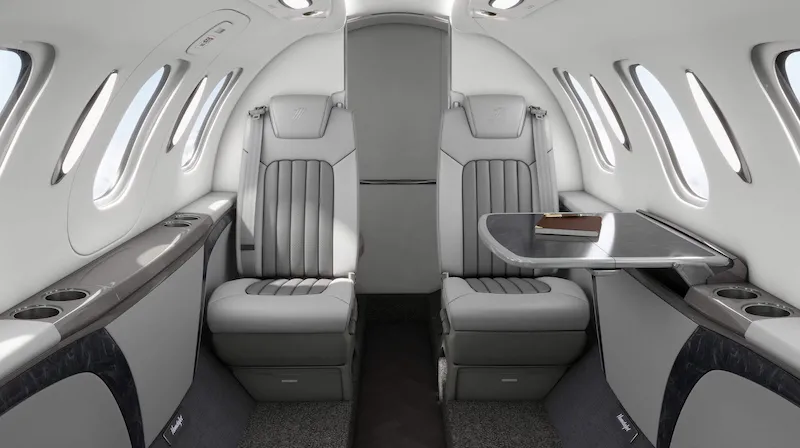
Entering the HondaJet Elite II, the first sensation is one of quiet, genuine, architectural quiet. Honda’s engineers invested heavily in acoustic treatment throughout the airframe, and the result is a noise profile that sits among the lowest in the very light jet category, making hour-long conversations possible at a conversational tone rather than the raised voice demanded by lesser cabins.
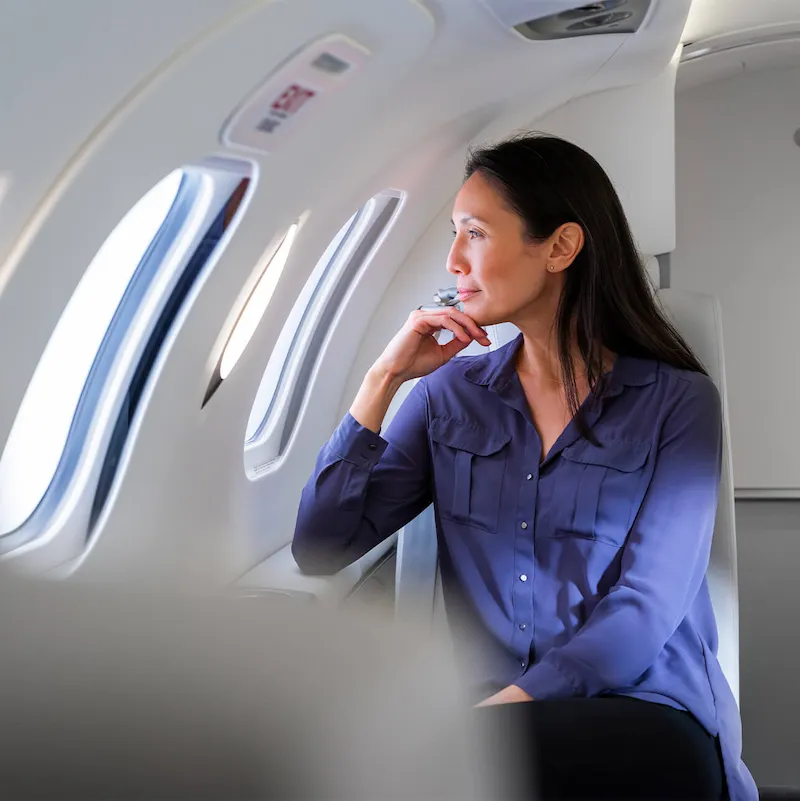
Overhead lighting washes the hand-stitched leather seating in a warm, directionless glow, and the large oval windows, generous by the standards of this class, pull views of the horizon inside with them.
Interior Layout & Seating
The standard configuration seats five passengers in a club-four-plus-one arrangement, with fully reclining seats dressed in premium leather selected from Honda’s curated material library.
Each position features individual reading lights, personal stowage, and sufficient legroom to stretch during the aircraft’s typical one-to-three-hour sector lengths.
A standout feature of the Elite II, made possible by the over-the-wing engine architecture, is the inclusion of a private aft lavatory, an exceptional amenity at this weight class that rivals simply cannot match.
The cabin altitude at cruise, maintained at just 6,413 feet at FL430, reduces traveler fatigue on back-to-back flight days, an often-overlooked wellness benefit that frequent fliers notice acutely.
HondaJet Elite II Connectivity & In-Flight Systems
The Elite II is available with an optional Ka-band satellite communications system, delivering broadband-grade in-flight Wi-Fi suitable for video conferencing and real-time document collaboration.
This capability, combined with USB and 12V power outlets at every seat, ensures that productivity does not pause at the boarding door.
A Bluetooth audio system integrates seamlessly with passengers’ devices for inflight entertainment without the tangle of cables.
HondaJet Elite II Galley & Baggage
A forward galley provides dedicated stowage for refreshments, hot beverages, and catering supplies, keeping service unobtrusive and the passenger zone undisturbed.
The aircraft’s 57 cubic feet of external baggage capacity, accessible via a pressurized compartment, accommodates the luggage demands of a five-passenger charter with considerable room to spare.

HondaJet Elite II Powerplant & Avionics
Performance & Engineering
Propulsion: GE Honda HF120
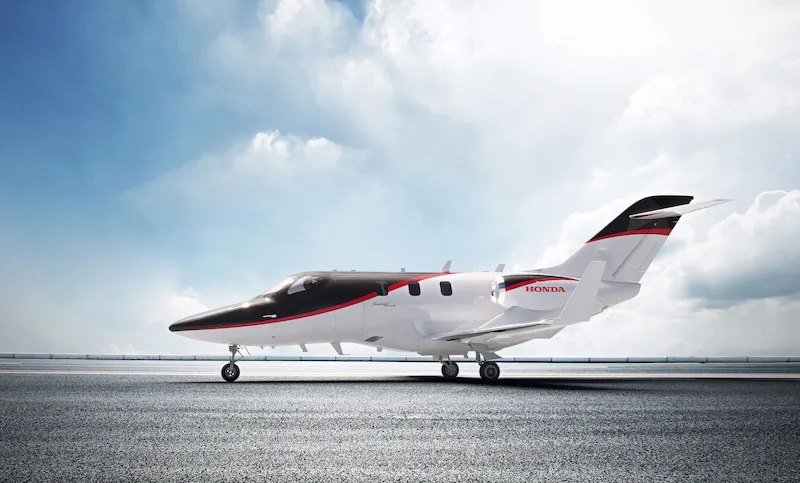
The Hondajet Elite II’s performance credentials begin with its powerplant: the GE Honda HF120, a purpose-built turbofan engine co-developed by GE Aviation and Honda Aero Inc.
Each engine produces 2,095 pounds of thrust and was designed from the outset for high efficiency in the very light jet operating envelope.
The HF120’s architecture prioritizes thermal efficiency at cruise altitudes, translating directly into lower fuel burn per seat-mile than many piston or older turbofan alternatives, a figure that matters not just to operators watching their fuel bills, but to clients increasingly attuned to the environmental footprint of their travel.
Runway Performance
With a short field takeoff performance that grants access to runways as brief as 3,934 feet, the Elite II opens a wider selection of regional airports than most competitors in its class.
This translates directly into shorter ground transfers for passengers — a tangible time saving that compounds across multi-leg itineraries.
Flight Deck – Avionics
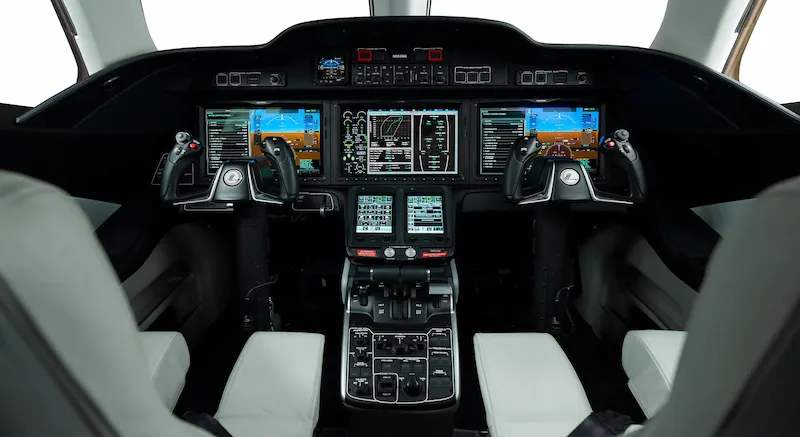
The flight deck is equipped with the Garmin G3000 avionics suite, presenting pilots with three 14.1-inch high-resolution touchscreen displays arranged across the instrument panel.
The G3000 integrates synthetic vision technology (SVT), ADS-B In/Out, TCAS I traffic alerting, terrain awareness (TAWS), and full-color weather radar into a unified interface that dramatically reduces cockpit workload.
The system supports single-pilot operations (SPO), expanding the pool of qualified crews available to charter operators and reducing repositioning costs, a genuine operational advantage.
Sustainability & SAF Compatibility
The GE Honda HF120 engines are compatible with Sustainable Aviation Fuel (SAF) blends up to current approved limits, enabling operators and charter clients to reduce net carbon emissions on every flight segment without modification or performance penalty.
In an era where ESG commitments increasingly shape corporate travel policies, the Elite II’s SAF readiness is a meaningful differentiator that conscientious operators are already leveraging in 2026.
HondaJet Elite II Objective Assessment
Strengths & Considerations
A frank evaluation for prospective charter clients considering the HondaJet Elite II in 2026.
Strengths
- Private aft lavatory — a feature unmatched among very light jets at this weight class, made possible solely by the over-the-wing engine configuration.
- Class-leading cabin acoustics — Honda’s investment in noise attenuation produces one of the quietest cabins in the VLJ segment, significantly enhancing passenger comfort on sector flights.
- Fuel efficiency & short-field access — the HF120’s low specific fuel consumption and the aircraft’s ability to operate from runways under 4,000 feet combine to reduce trip costs and maximize destination choices.
Considerations
- Range constraints vs. light jets — the Elite II’s 1,437 nm ceiling means transcontinental US routes or transatlantic hops require a fuel stop, ceding ground to larger light jets such as the Cessna Citation CJ4 or Embraer Phenom 300E.
- Limited payload flexibility — at MTOW of 10,600 lb, loading five passengers with full baggage and maximum fuel simultaneously requires careful weight-and-balance planning, occasionally forcing a range trade-off on heavier missions.
HondaJet Elite II Competitive Landscape
Market Comparison
The very light jet market in 2026 is defined by a handful of capable platforms. The two aircraft most frequently evaluated alongside the HondaJet Elite II are the Cessna Citation M2 Gen2 and the Embraer Phenom 100EV. Each occupies overlapping price and performance territory, yet clear differentiators emerge on closer inspection.
| Metric | HondaJet Elite II | Cessna Citation M2 Gen2 | Embraer Phenom 100EV |
|---|---|---|---|
| Max Range (NBAA IFR) | 1,437 nm | 1,550 nm | 1,178 nm |
| Max Cruise Speed | 422 ktas | 404 ktas | 390 ktas |
| Typical Passenger Capacity | 5 pax | 6 pax | 4 pax (standard) |
| Private Aft Lavatory | Yes | No | No |
| Max Operating Altitude | FL430 | FL410 | FL410 |
| SAF Compatibility | Yes | Yes | Yes |
| Price range | From $3,200/hr | From $3,000/hr | From $2,500/hr |
HondaJet Elite II vs. Cessna Citation M2 Gen2
The Citation M2 Gen2 edges the Elite II in both maximum range and passenger capacity, making it the marginally stronger tool for operators who regularly fly six passengers or push toward the 1,500 nm boundary.
However, the M2 Gen2 cannot match the Elite II’s top-end cruise speed of 422 ktas, its private lavatory, or its higher service ceiling of FL430, the latter allowing the Honda to climb above weather and turbulence that the Citation must navigate through.
For the passenger who values speed, acoustics, and cabin privacy above absolute range, the Elite II is the superior choice.
HondaJet Elite II vs. Embraer Phenom 100EV
The Phenom 100EV is a highly respected platform, but it trails the Elite II decisively on range, cruise speed, and service ceiling.
Embraer’s cabin design carries the brand’s characteristic Brazilian engineering confidence, yet the Phenom’s four-passenger standard configuration and the absence of a private lavatory place it a step behind the Honda in overall passenger experience.
For charter clients considering the Phenom 100EV, the Elite II presents a compelling upgrade argument with a modest premium.
FREQUENTLY ASKED QUESTIONS
HondaJet Elite II Charter Specifications & Booking Essentials
How much does it cost to charter a HondaJet Elite II?
The HondaJet Elite II charters for approximately $3,200 to $4,500 per flight hour. As Honda Aircraft’s flagship very light jet, it delivers class-leading speed and range for its category, making it an efficient choice for point-to-point trips up to roughly 1,500 nautical miles. Exact pricing depends on your specific route, aircraft positioning, scheduling, and any additional in-flight requests. Request a quote for exact HondaJet Elite II pricing on your trip.
Is luxury catering included in the HondaJet Elite II charter price?
Base hourly rates cover the aircraft, professional crew, and fuel, but luxury catering is arranged separately given the HondaJet Elite II’s compact very-light-jet cabin and galley space. We can still coordinate premium in-flight dining, from light gourmet snacks and boxed meals to more elaborate spreads for shorter regional hops, scaled appropriately to the aircraft. Share your catering preferences with your charter agent in advance so it can be built into your itinerary and cost estimate.
Are there any empty-leg options for the HondaJet Elite II?
Empty-leg flights on the HondaJet Elite II do become available, particularly as newer-delivery aircraft enter the charter market and reposition between bookings. Because the Elite II fleet is smaller than more established light jets, empty-leg inventory is less frequent but can offer significant savings when the timing and route align with your travel plans.
How many passengers can the HondaJet Elite II carry?
The Elite II is configured to comfortably seat up to five to six passengers depending on layout, making it well suited to small executive groups or family travel. Exact seating configuration should be confirmed against the specific tail number’s cabin layout at the time of quoting.
What is the range of the HondaJet Elite II, and which routes can it fly nonstop?
The Elite II offers class-competitive range for a very light jet, suitable for most short to medium-haul domestic sectors without a fuel stop. For specific city-pair feasibility, request a route-specific check, since payload, winds, and runway length all affect achievable range on a given day.
How far in advance do I need to book a HondaJet Elite II charter?
Light jets like the Elite II are frequently available on short notice, including same-day or next-day departures depending on operator positioning near your origin airport. For guaranteed availability during peak travel periods, earlier requests give access to a wider set of verified aircraft.
How does the HondaJet Elite II compare to other light jets like the Phenom 300E or Citation CJ4?
The Elite II distinguishes itself with its over-the-wing engine design, which improves cabin space and fuel efficiency relative to conventional light jet layouts, while the Phenom 300E and CJ4 lean toward higher cabin volume and speed respectively. The right choice depends on your typical mission profile, passenger count, and preferred trade-off between efficiency and cabin size.
Can I bring pets or extra luggage on a HondaJet Elite II charter?
Pet-friendly travel is generally accommodated on Elite II charters, though cabin and baggage space is more limited than on midsize or heavy jets, so oversized luggage may require advance coordination with the operator. Confirming baggage volume and pet policy at the time of booking avoids surprises at departure.
Do I need a membership or jet card to charter a HondaJet Elite II?
No membership is required to request availability or pricing through this page. Quotes are sourced directly from certified operators on an on-demand basis, giving you access without the upfront commitment of a card or membership program.
What Our Passengers Say
The Proof is in the Flight
Begin Your Journey
Request your HondaJet Elite II charter quote today
Whether you are coordinating a same-week mission, our aviation consultants are available to structure an itinerary, provide transparent charter pricing, and ensure every detail reflects the standard your travel demands. In 2026, private aviation moves fast, and so should your decision.
REQUEST INSTANT QUOTATION
[jet_search]
1 All charter rates quoted on request. Availability subject to operator schedule. Specifications sourced from manufacturer data and may vary by serial number and operator configuration. The rates and price ranges displayed on this website are for informational and estimation purposes only. Actual charter costs may vary based on aircraft availability, operator positioning, seasonal demand, real-time fuel surcharges, landing fees, and specific flight itineraries. InstantPrivateJet.com is an independent marketplace and information resource. We do not own, manage, or operate aircraft. All charters are arranged, quoted, and fulfilled directly by third-party air carriers certified by the FAA (or equivalent civil aviation authorities). Final quotes and legally binding terms will be provided directly by the operating air carrier prior to booking.