
REQUEST INSTANT QUOTATION
[jet_search]
Video courtesy of Pilatus-aircraft.com
Charter the Pilatus PC-12 NGX: Rates, Range & Availability
Pilatus PC-12 NGX Price Per Hour, Specifications & Fleet Availability
Data & Prices Updated September 2026 1
When you charter a Pilatus PC-12 NGX, you’re booking one of the most operationally flexible single-engine turboprops in private aviation, capable of reaching short regional strips and unpaved runways that larger cabin jets cannot access. Prices range from $1,800 to $3,200 per flight hour. Through this page, you can request a live quote and current fleet availability for this specific aircraft, matched to your departure airport and travel dates.
REQUEST INSTANT QUOTATION
[jet_search]
Every operator in our network is vetted for certification standing, crew currency, and maintenance records, and our team returns pricing and tail availability within hours, not days, with access extending across major charter markets in North America and beyond.
For regional corporate travel, remote site logistics, and budget-conscious flight departments, the Pilatus PC-12 NGX provides an exceptional operational advantage.
Pairing short-field performance on unpaved runways with a Pratt & Whitney Canada PT6E-67XP powerplant, boasting over 99.9% dispatch reliability, the airframe cuts direct charter costs by 30–50% compared to light jets on sectors under 1,000 nautical miles. It remains the ultimate solution for bringing executives closer to their final destination without sacrificing cabin comfort or operational efficiency.
This is not a compromise aircraft. It is a deliberate choice, the most capable single-engine turboprop ever certified, evolved through four decades of operator feedback into a machine that combines short-field performance, exceptional payload, and a genuinely refined cabin into one airframe.
This guide highlights how the PC-12 NGX delivers executive jet comfort directly to your destination, saving you valuable time while optimizing your travel budget.
Why Choose Us for Private Jet Charter
Every operator in our network holds current FAA Part 135 certification, or the EASA equivalent for European operators, the regulatory standard governing commercial charter operations, crew duty limits, and aircraft maintenance oversight. Combined with ARGUS/Wyvern ratings, this means every aircraft you fly with us has passed both government-mandated safety audits and independent third-party vetting.











Pilatus PC-12 NGX Technical Overview
Key Specifications
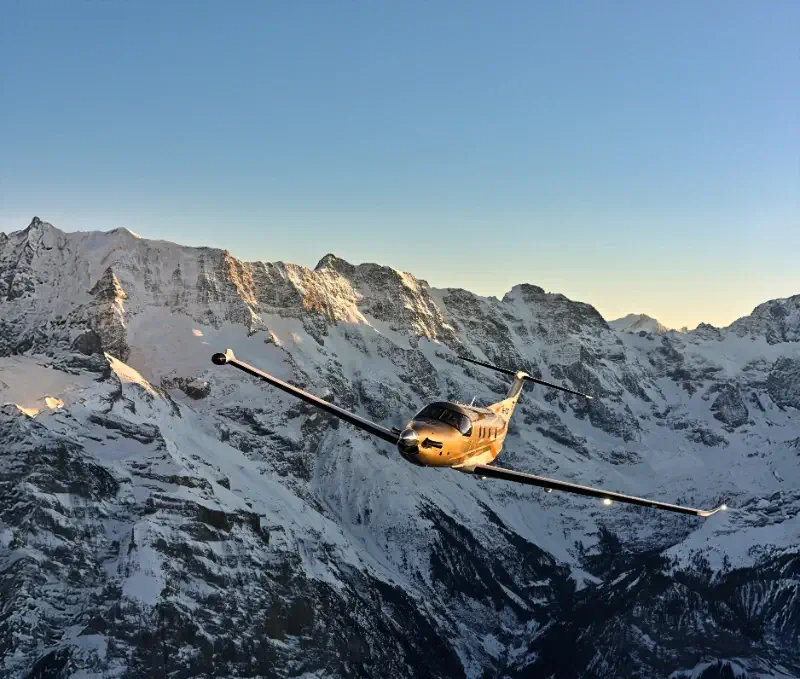
All figures reflect Pilatus Aircraft standard published data. Operators should confirm performance parameters with their charter operator for specific mission planning.
| Specification | Value & Notes |
|---|---|
| Maximum Range | 1,803 nm (3,339 km) — NBAA IFR reserves, with standard passenger load |
| Maximum Cruise Speed | 290 ktas at FL300 — typical high-speed cruise; long-range cruise approx. 268 ktas |
| Takeoff Distance | 689 m (2,260 ft) — ISA, sea level, MTOW; significantly shorter at reduced payload or higher altitudes on hot days with appropriate charts |
| Landing Distance | 503 m (1,650 ft) — ISA, sea level; unpaved surface operations certified |
| Typical Seating Configuration | 9 passengers in club or airline configuration; factory air ambulance, cargo, and combi layouts available |
| Maximum Payload | 1,313 kg (2,894 lb) — maximum zero-fuel weight basis |
| Cabin Volume | 13.6 m³ (480 cu ft) including aft cargo; usable cabin approx. 265 cu ft |
| Service Ceiling | FL300 (30,000 ft) — pressurized cabin altitude ≤ 8,000 ft at FL250 |
| Powerplant | Pratt & Whitney Canada PT6E-67XP, 1,825 shp — FADEC-controlled, dual-channel; rated TBO 5,000 hours |
| Maximum Takeoff Weight (MTOW) | 4,740 kg (10,450 lb) |
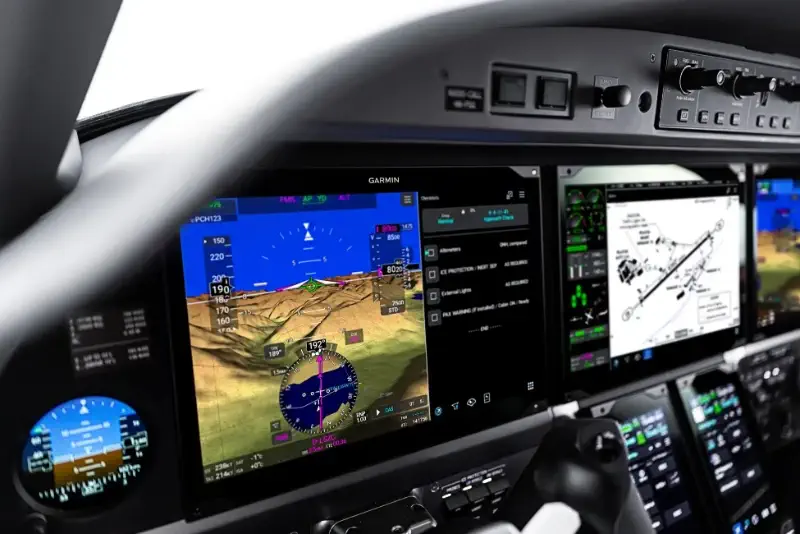
| Avionics Suite | Honeywell Primus Apex with autothrottle, synthetic vision, datalink; optional ADS-B Out compliant |
PC-12 NGX Interior & Amenities
Cabin Versatility & Passenger Comfort
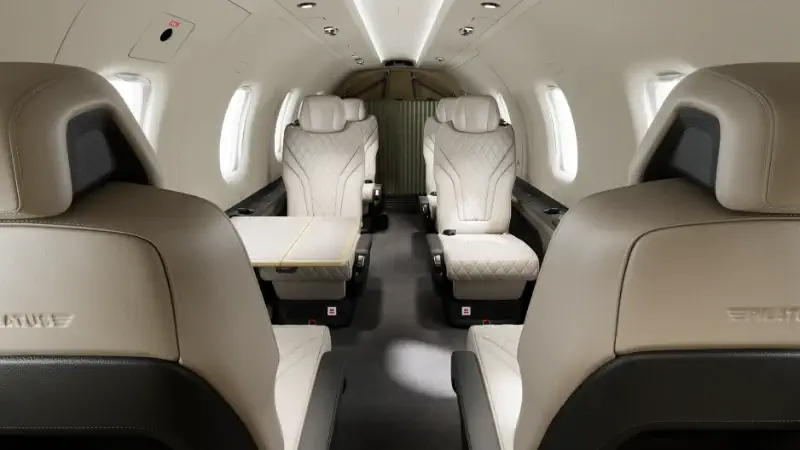
The PC-12 NGX cabin measures 4.57 m (15 ft) in length, 1.27 m (4 ft 2 in) in width, and 1.30 m (4 ft 3 in) in height, compact by midsize jet standards, but intelligently engineered.
Pilatus’s cabin design philosophy prioritizes usable volume over raw dimensions: club seating for six accommodates genuine face-to-face working sessions, while the optional nine-seat commuter configuration addresses the regional feeder and fly-in lodge operator market.
Modular Configurations & Cargo Door
A defining structural asset is the PC-12 NGX’s large rear cargo door, measuring 1.32 m × 1.32 m (52 in × 52 in), the widest cargo aperture in its class. This enables rapid conversion between passenger, cargo, and air ambulance (medevac) configurations, making the aircraft the charter platform of choice for humanitarian operators, offshore energy companies, and remote lodge operators who require genuine freight-forwarding capability alongside executive transport.
- Full medevac configuration with one or two stretcher positions, medical monitoring equipment mounts, and attendant seating
- Standard executive interior: 6 club seats with individual armrests and fold-out tables; bespoke upholstery packages available through Pilatus authorized completion centers
- High-density commuter fit: 9 forward-facing seats for regional route operations, fly-in lodge shuttles, and corporate shuttle missions
- Combi layout: forward passenger seating + rear cargo pallet — industry standard for exploration, mining, and remote-site access
Pressurization & Cabin Altitude
The PC-12 NGX operates with a cabin differential pressure of 6.0 psi, maintaining a cabin altitude of 8,000 ft or below up to the aircraft’s FL300 service ceiling.
At typical regional cruise altitudes of FL240–FL270, passengers experience a cabin altitude equivalent to approximately 5,500–6,500 ft — a meaningful physiological advantage over unpressurized turboprops during multiple-sector days.
Vibration, Acoustics & the PT6E Experience
The PT6E-67XP’s FADEC (Full Authority Digital Engine Control) system, a landmark advance in the NGX generation over the legacy PT6A variants, enables precisely managed propeller RPM scheduling that materially reduces cabin noise and vibration relative to earlier PC-12 iterations.
While single-engine turboprops cannot match the acoustic refinement of pressurized jets, Pilatus’s airframe-level acoustic treatment and the NGX’s five-blade composite propeller contribute to a cabin sound environment that operators describe as compatible with productive business conversations without headset use.
REQUEST INSTANT QUOTATION
[jet_search]
Powerplant & Avionics
Performance & Engineering
Propulsion: PT6E-67XP
The Pratt & Whitney Canada PT6 engine family has accumulated more than 400 million flight hours across commercial, military, and general aviation applications, a safety and reliability heritage unmatched in its segment.
The PT6E-67XP variant introduced with the NGX adds dual-channel FADEC to an already proven core, enabling automated power management, reduced pilot workload, and optimized fuel scheduling throughout all phases of flight. TBO is rated at 5,000 hours, with a global service network capable of supporting remote operations in over 100 countries.
Fuel Efficiency & Sustainability
For missions under 600 nm, the PC-12 NGX presents a compelling environmental and economic case versus light jets. Burning approximately 295 liters (78 USG) per hour at typical cruise, the PC-12 NGX consumes 35–45% less fuel per sector than comparable light jets on equivalent regional hops, translating directly into lower charter cost per seat and a meaningfully smaller carbon footprint.
For operators with Sustainable Aviation Fuel (SAF) programs, the PT6E-67XP is fully approved for up to 50% SAF blend ratios under current certifications, with Pratt & Whitney committing to 100% SAF compatibility by 2026.
- Lower noise footprint enables access to noise-sensitive airfields where jet operations may be restricted
- Fuel burn approx. 295 L/hr at long-range cruise, benchmark efficiency for pressurized single-engine turboprops
- SAF-compatible up to 50% blend ratio on approved PT6E-67XP variants
- Single-engine operating costs translate to charter rates 20–40% lower than twin-engine turboprops of comparable capability
Short-Field & Backcountry Access
The PC-12 NGX’s Short Takeoff and Landing (STOL) capability is the keystone of its operational case.
A balanced field length of under 690 m at MTOW means the aircraft routinely operates from airstrips that eliminate jet operations entirely: mountain aerodrome environments in the Alps, Andes, and Rockies; gravel and packed-earth strips in arctic Canada, sub-Saharan Africa, and the Australian outback; and short coastal platforms serving island-hopping itineraries across the Pacific and Caribbean.
Pilatus certifies the PC-12 NGX for operations on unpaved, grass, and snow-compacted surfaces — no other pressurized aircraft in its payload class matches this authorization.
Our Objective Assessment
Strengths & Considerations
Strengths
- Unmatched airfield access. Certified for unpaved, grass, gravel, and snow-compacted surfaces with a takeoff run under 690 m at MTOW, opens destinations permanently inaccessible to jets and most twin turboprops.
- Superior payload for the category. A maximum payload of 1,313 kg (2,894 lb) and the widest cargo door in class make the PC-12 NGX the only pressurized single capable of genuine freight-plus-passenger combi operations.
- Charter economics with cabin credibility. Single-engine operating costs and 35–45% fuel savings over light jets on sub-600 nm sectors translate to competitive charter rates without sacrificing pressurization, club seating, or executive-grade avionics.
Considerations
- Speed penalty on longer sectors. At 290 ktas maximum cruise, the PC-12 NGX is approximately 80–120 knots slower than the light jets it competes with on cost. On sectors above 800 nm, the time differential, potentially 1.5–2.5 hours, becomes a meaningful consideration for time-critical executives.
- Service ceiling constraint. The FL300 ceiling places the PC-12 NGX below the weather-avoidance altitude of most light and midsize jets. In convective environments or mountainous overwater routing, this can require lower, turbulence-exposed flight levels that may increase journey times and passenger comfort impact.
Competitive Landscape of the Pilatus PC-12 NGX
Market Comparison
The PC-12 NGX competes across two distinct mission profiles: against comparable single-engine turboprops and against Very Light Jets (VLJs) on cost-per-seat regional routes. The two most frequently cited alternatives are the Daher TBM 960 (single-engine pressurized turboprop) and the Cirrus Vision Jet SF50 (VLJ).
| Parameter | Pilatus PC-12 NGX | Daher TBM 960 | Cirrus Vision Jet SF50 |
|---|---|---|---|
| Max Range | 1,803 nm | 1,730 nm | 1,275 nm |
| Max Cruise Speed | 290 ktas | 330 ktas | 311 ktas |
| Takeoff Distance (MTOW) | 689 m (2,260 ft) | 870 m (2,854 ft) | 1,036 m (3,400 ft) |
| Passenger Capacity | 9 passengers | 5 passengers | 7 passengers |
| Max Payload | 1,313 kg (2,894 lb) | ~700 kg | ~450 kg |
| Service Ceiling | FL300 | FL310 | FL280 |
| Unpaved Surface Ops | Yes — certified | No | No |
| Cargo Door | Yes — 1.32 × 1.32 m | No | No |
| Price Range | From $1,800/hr | From $1,800/hr | From $1,900/hr |
Pilatus PC-12 NGX vs. Daher TBM 960
The TBM 960 holds a legitimate advantage in cruise speed, approximately 40 knots faster than the PC-12 NGX at altitude, making it the preferred option for corporate passengers where journey time on sub-500 nm sectors is the primary decision variable and remote airfield access is not required.
However, it cannot approach unpaved surfaces, cannot accommodate more than five passengers, and its payload is less than 55% of the NGX’s maximum.
Pilatus PC-12 NGX vs. Cirrus Vision Jet SF50
The Vision Jet SF50 delivers jet speeds and the psychological value of a jet category certificate, but its seven-passenger practical limit, restricted range, and hard requirement for prepared paved surfaces disqualify it immediately from the remote-access missions that define the NGX’s charter value proposition.
Expert Verdict
For charter flight customers in 2026, the combination of short-field performance and payload capacity makes the PC-12 NGX the smartest choice for missions that demand runway independence.
FREQUENTLY ASKED QUESTIONS
Pilatus PC-12 Charter Specifications & Booking Essentials
How much does it cost to charter a Pilatus PC-12 NGX?
Plan on roughly $1,800 to $3,200 per flight hour for a PC-12 NGX charter. It’s the newest generation of the best-selling pressurized single-engine turboprop in the world, and the upgraded engine and avionics in the NGX variant push it slightly above older PC-12 pricing, though it still undercuts most light jets by a wide margin.
Submit your route and dates for a firm quote reflecting current fuel and availability rather than a generic estimate.
How many passengers can the Pilatus PC-12 NGX carry?
The PC-12 NGX is typically configured to seat between six and nine passengers depending on the operator’s cabin layout, with several configurations offering a club seating arrangement and a private aft cargo/baggage area. We confirm the exact seating configuration for the specific tail assigned to your trip before booking.
What is the range of the Pilatus PC-12 NGX, and which routes can it fly nonstop?
The PC-12 NGX offers a long-range capability for a single-engine aircraft, comfortably covering many transcontinental domestic routes without a fuel stop. Exact range depends on payload, winds, and reserves, so we recommend confirming nonstop feasibility for your specific city pair when you request a quote.
How far in advance do I need to book a Pilatus PC-12 NGX charter?
The PC-12 NGX’s broad operator network and shorter positioning requirements often allow for same-day or next-day availability, subject to aircraft location and crew duty limits at the time of request. For guaranteed scheduling around a fixed event, we recommend submitting your request as early as possible.
How does the Pilatus PC-12 NGX compare to other light aircraft for charter?
Compared to light jets, the PC-12 NGX offers a larger cabin cross-section, a rear cargo door for oversized baggage or equipment, and access to shorter or unpaved runways that light jets cannot use, trading some cruise speed for that flexibility. We can help you compare it directly against light jet alternatives based on your specific route and payload.
Can I bring pets or oversized luggage on a Pilatus PC-12 NGX charter?
Most PC-12 NGX operators accommodate pets in the cabin and support oversized equipment or luggage through the aircraft’s large cargo door, though policies vary by operator. Confirm specific pet and baggage requirements with your assigned operator once your quote is issued.
Do I need a membership or jet card to charter a Pilatus PC-12 NGX?
No membership is required. Charter requests through this page are handled as on-demand, single-trip bookings matched against certified operators’ live availability for this aircraft, with no recurring fees or minimum usage commitments.
Are there any empty-leg options for the Pilatus PC-12 NGX?
Absolutely, and given how large the PC-12 fleet is worldwide, empty legs on this aircraft are some of the easiest to come by in the turboprop segment. Operators reposition these constantly between missions, so flexible travelers often find meaningful savings if they’re willing to work around an existing route.
Please, visit our EMPTY-LEG page to check current rates for chartering a Pilatus PC-12 NGX.
What Our Passengers Say
The Proof is in the Flight
Begin Your Journey
Request your Pilatus PC-12 NGX charter quote today
Whether you are planning a fly-in to a remote lodge, a multi-stop corporate tour through secondary markets, a medevac positioning flight, or a cost-benchmarked alternative to your existing jet contract, our turboprop charter specialists are ready to build the most efficient routing for your mission.
Charter a Pilatus PC-12 NGX in 2026 to access over 3,000 unpaved and short-field airstrips, extending far beyond standard airport networks..
REQUEST INSTANT QUOTATION
[jet_search]
1 All charter rates quoted on request. Availability subject to operator schedule. Specifications sourced from manufacturer data and may vary by serial number and operator configuration. The rates and price ranges displayed on this website are for informational and estimation purposes only. Actual charter costs may vary based on aircraft availability, operator positioning, seasonal demand, real-time fuel surcharges, landing fees, and specific flight itineraries. InstantPrivateJet.com is an independent marketplace and information resource. We do not own, manage, or operate aircraft. All charters are arranged, quoted, and fulfilled directly by third-party air carriers certified by the FAA (or equivalent civil aviation authorities). Final quotes and legally binding terms will be provided directly by the operating air carrier prior to booking.